
Table of Contents
Overview – T-Cell Development
T-cell development is a tightly regulated, multi-stage process by which hematopoietic stem cells differentiate into immunocompetent T lymphocytes. This occurs predominantly in the thymus and continues in peripheral lymphoid organs. The goal of T-cell development is to generate a diverse, self-tolerant, and antigen-responsive pool of T-cells — essential for adaptive cellular immunity. T-cell development ensures both central tolerance (via positive and negative selection) and the generation of CD4 and CD8 T-cells with distinct roles in immune defence.
Development in the Thymus
Step 1 – Entry of Double-Negative Thymocytes
- Immature T-cell precursors (double-negative thymocytes; no CD4 or CD8 expression) enter the thymus via high endothelial venules (HEVs) at the cortico-medullary junction
- Migrate to the subcapsular region, where TCR gene rearrangement begins


Step 2 – TCR Gene Rearrangement
- β (or δ) chain rearrangement: V, D, J segments recombine
- α (or γ) chain rearrangement: V and J segments recombine
- Two TCR lineages:
- αβ T-cells (majority): become CD4 or CD8 cells
- γδ T-cells (minority): innate-like, non-MHC restricted, epithelial-resident
- Key enzymes: RAG-1, RAG-2 recombinases and ligases
- Result: T-cells with diverse TCRs, each specific to a unique antigen-MHC complex

Step 3 – TCR Expression
- TCR proteins are expressed on the cell surface of developing thymocytes
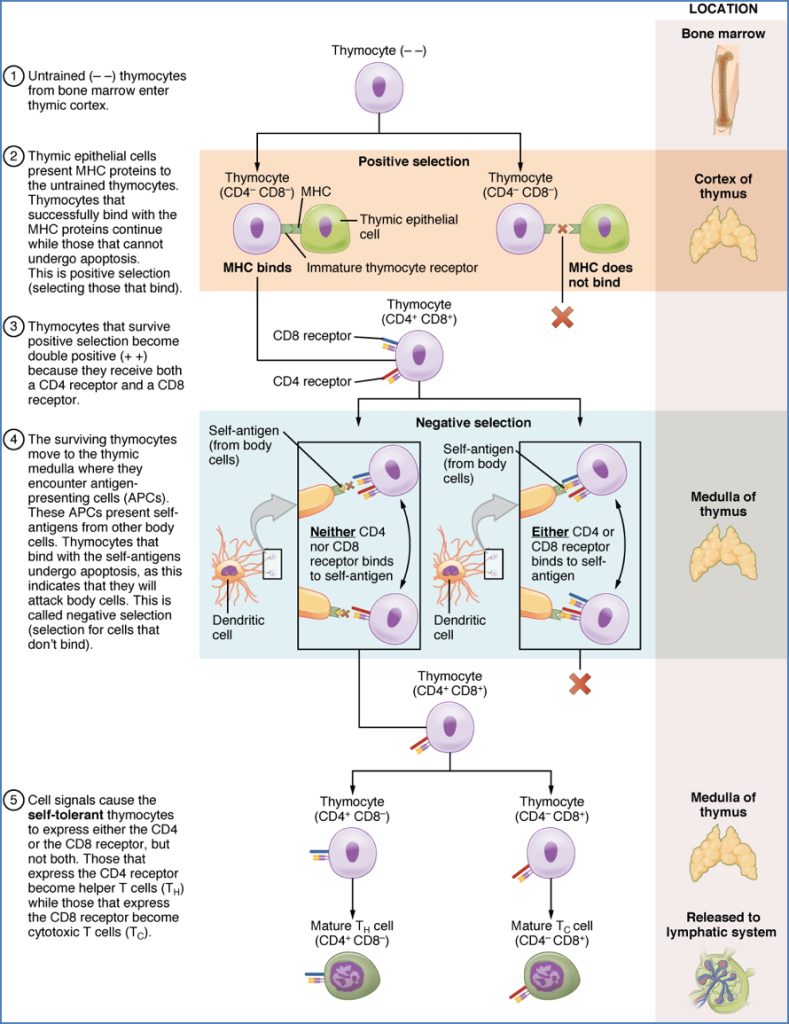
Step 4 – Differentiation into Double-Positive (DP) Thymocytes
- Thymocytes express both CD4 and CD8 → now termed double-positive
- Migrate into the cortex of the thymus
Step 5 – Positive Selection (Cortex)
- Thymic epithelial cells present self-peptides on MHC-I and MHC-II
- Thymocytes that successfully bind:
- MHC-I → retain CD8 expression → become CD8+ T-cells
- MHC-II → retain CD4 expression → become CD4+ T-cells
- Cells that fail to bind either MHC class receive no survival signal → apoptosis
Step 6 – Negative Selection (Medulla)
- CD4 and CD8 single-positive thymocytes move to thymic medulla
- Encounter medullary APCs presenting self-antigen
- Thymocytes that bind too strongly are deleted → prevents autoimmunity
- Ensures central tolerance
Step 7 – Exit of Mature Naive T-Cells
- Surviving CD4 and CD8 naive T-cells exit the thymus
- Enter peripheral circulation and home to secondary lymphoid organs
Activation in Peripheral Lymphoid Organs
Step 8 – Antigen Recognition
- APCs present peptide antigens on MHC-I or MHC-II
- CD4 T-cells → recognise MHC-II:peptide
- CD8 T-cells → recognise MHC-I:peptide
- TCRs do not bind whole antigen — peptide must be MHC-bound
- Exception: superantigens bypass this restriction (see MHC section)
Step 9 – T-Cell Activation
Three signals are required for full T-cell activation:
- Activation Signal – TCR binds to MHC:peptide complex
- CD4 binds to MHC-II
- CD8 binds to MHC-I
- Survival Signal – Co-stimulation:
- CD28 binds to CD80/CD86 on APC
- CD40 binds to CD40L (especially in CD4+ T-cells)
- 4-1BB binds to its ligand (CD8-specific)
- Triggers IL-2 synthesis → drives proliferation
- Differentiation Signal – Cytokines from APCs or innate immune cells:
- IL-12, IFN-γ → Th1
- IL-4 → Th2
- IL-6, TGF-β → Th17
- IL-10, TGF-β → T-reg
- IL-2 → promotes CD8 differentiation


Effector Functions
CD4 Helper T-Cells
- Recognise MHC-II:peptide (extracellular pathogens)
- Th1: Activate macrophages, assist CD8 and B-cells (via IFNγ, IL-2, CD40L)
- Th2: Support B-cell antibody class-switching (via IL-4, IL-5, TGF-β)
- Th17: Recruit neutrophils (via IL-17)
- T-reg: Suppress immune responses (via IL-10, TGF-β)
CD8 Cytotoxic T-Cells
- Recognise MHC-I:peptide (intracellular pathogens, cancer)
- Kill target cells via cytotoxic granules:
- Perforin, Granzymes, Granulysin
- Activate caspases or death receptors (e.g. Fas) → Apoptosis
- Also secrete:
- IFNγ (inhibits viral replication)
- TNFα (pro-inflammatory)

Memory T-Cells
- Long-lived, persist at higher levels than naive cells
- Rapidly respond to repeat antigen exposure
- Can quickly differentiate into effector cells
Summary – T-Cell Development
T-cell development begins in the thymus with TCR gene rearrangement and selection, followed by peripheral activation and functional differentiation into helper, cytotoxic, or regulatory T-cells. Each stage ensures self-tolerance and immunocompetence. Mature T-cells are essential for cell-mediated immunity, playing roles in pathogen clearance, immune regulation, and immune memory. For more, see our Immune & Rheumatology Overview page.