
Table of Contents
Overview – Pathogenicity
Pathogenicity refers to the capacity of a microbe to cause disease in a host. It involves a complex interplay between the organism’s virulence factors and the host’s immune defences. Understanding how pathogens invade, replicate, and evade immunity is fundamental for medical students studying infectious disease, epidemiology, and host-pathogen interactions. This article explores the distinctions between normal flora and pathogens, stages of infection, modes of transmission, and immune evasion mechanisms employed by viruses, bacteria, and parasites.
Definition
- Pathogenicity: The ability of an organism to cause disease.
- Distinct from virulence, which quantifies the severity of disease caused.
Normal Flora vs Pathogens
Normal Flora (Commensals)
- Typically non-pathogenic, and often beneficial:
- Compete with pathogens for space and nutrients.
- Their loss (e.g. via antibiotics) can allow pathogen overgrowth.
- Colonisation sites:
- Skin: Armpits, perineum, interdigital spaces
- Mucous membranes: Nasopharynx, gastrointestinal tract, urogenital tract
- Gastrointestinal Tract (GIT):
- Microbial density increases toward the rectum
- Species vary by pH, oxygenation, and nutrient availability
- Sterile areas (should not contain any microbes):
- Blood, internal organs, bladder
- Aerobic vs Anaerobic flora:
- Aerobic → Oxygen-rich areas (e.g. respiratory tract)
- Anaerobic → Oxygen-poor sites (e.g. colon, necrotic tissue)
- Nosocomial infections:
- Occur when commensals colonise inappropriate areas
- Often multi-drug resistant, particularly in hospital settings

Features of Pathogens
To be classified as a pathogen, an organism must:
- Gain entry to the host
- Attach to host tissues and multiply
- Evade host defences
- Cause damage to cells or tissues
Types of Pathogens
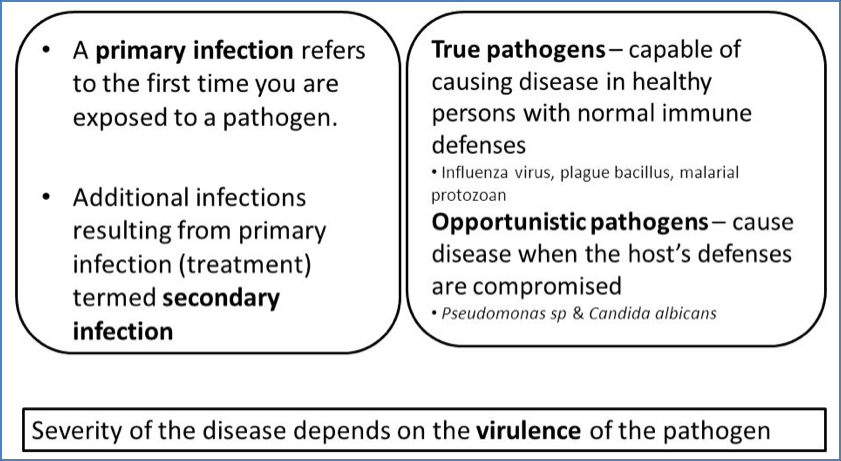
- Primary pathogens: Cause disease independently (e.g. HIV)
- Secondary (opportunistic) pathogens: Cause disease after host defences are compromised by a primary pathogen
Virulence
- Virulence: The degree of pathogenicity of an organism
- Influenced by:
- Case-fatality rate
- Tissue invasion and damage
- Immune evasion strategies
- Toxin production
- Virulence factors include:
- Endotoxins (e.g. lipopolysaccharide)
- Exotoxins (e.g. tetanus toxin)
- Fungal mycotoxins (e.g. aflatoxin)
- IgA proteases (e.g. Streptococcus pyogenes)
- Capsules to inhibit phagocytosis
Pathogenesis – 4 Stages of Infection
- Entry into host
- Routes: Oral, skin breaches, transplacental, inhalation, sexual contact, inoculation
- Exogenous (from outside) or endogenous (commensals in immunocompromised hosts)
- Attachment and multiplication
- Mechanisms of attachment:
- Glycoproteins (viruses), fimbriae/pili (bacteria), hooks/suckers (helminths)
- Spread:
- Local: Mucosal, nerve, cerebrospinal fluid
- Systemic: Bloodstream → sepsis
- Influencing factors:
- Organism: Virulence factors
- Host: Age, immunity, nutrition, genetics
- Mechanisms of attachment:
- Immune evasion
- Physical: Survive flushing, mucociliary clearance, stomach acid
- Innate immune evasion: Inhibit phagocytosis, resist complement
- Adaptive immune evasion: Destroy antibodies, downregulate MHC, inhibit T cells
- Tissue damage
- Mechanisms:
- Physical destruction
- Toxin-mediated damage
- Aberrant host cell activity
- Immune-mediated pathology
- Mechanisms:

Transmission
Requirements for Transmission
- Successful exit from host
- A vehicle for spread (e.g. fluids, vectors, air)
- Ability to survive in the external environment
- Sufficient numbers for the infective dose
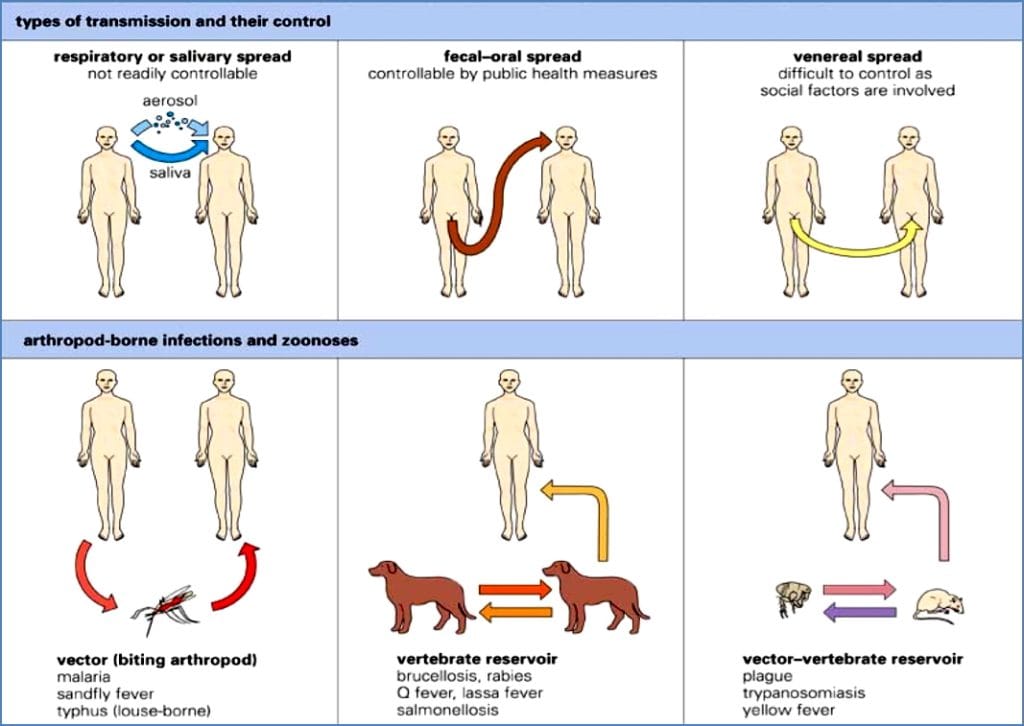
Types of Transmission
- Airborne (e.g. influenza)
- Waterborne (e.g. cholera)
- Foodborne (e.g. salmonella, preformed toxins)
- Vertical: Parent to offspring
- Horizontal: Person to person
- Zoonotic: Animal to human (via contact, bites, inhalation)
Epidemiology of Pathogenicity
- Study of the distribution and determinants of infectious disease
- Affected by:
Organism
- Mutation or variation in virulence
- Introduction of new pathogens
Host
- Changes in susceptibility (e.g. immunosuppression, age)
- Changes in population density or behaviour
Environment
- Seasonal variation (e.g. cold weather → indoor crowding)
- Changes in vector populations (e.g. mosquitoes post-rain)
Immune Evasion Strategies
Viruses
- Latency (e.g. herpesvirus)
- Superantigens → immune hyperactivation
- Inhibit MHC I presentation
Bacteria
- Block phagocytosis
- Suppress cellular immunity
- Induce host cell apoptosis
- Produce enzymes (e.g. superoxide dismutase) to resist neutrophil attack
- Evade phagolysosomal fusion
- Intracellular spread without extracellular exposure
Protozoan Parasites
- Antigenic variation and drift
- Molecular mimicry
- Intracellular localisation
- Sequestration in immune-privileged sites
- Block fusion of lysosomes
- Modulate host responses
Helminths
- Shed surface antigens
- Produce proteases to degrade antibodies
- Suppress or redirect immune responses
- Use host cytokines to promote growth
- Skew helper T-cell responses (reduce anti-parasitic IgE production)
Summary – Pathogenicity
Pathogenicity describes an organism’s capacity to invade, replicate, and cause harm within a host. Through virulence factors, immune evasion strategies, and efficient transmission, microbes exploit host vulnerabilities to establish infection. For a broader context, see our Microbiology & Public Health Overview page.