
Table of Contents
Overview – The Pancreas
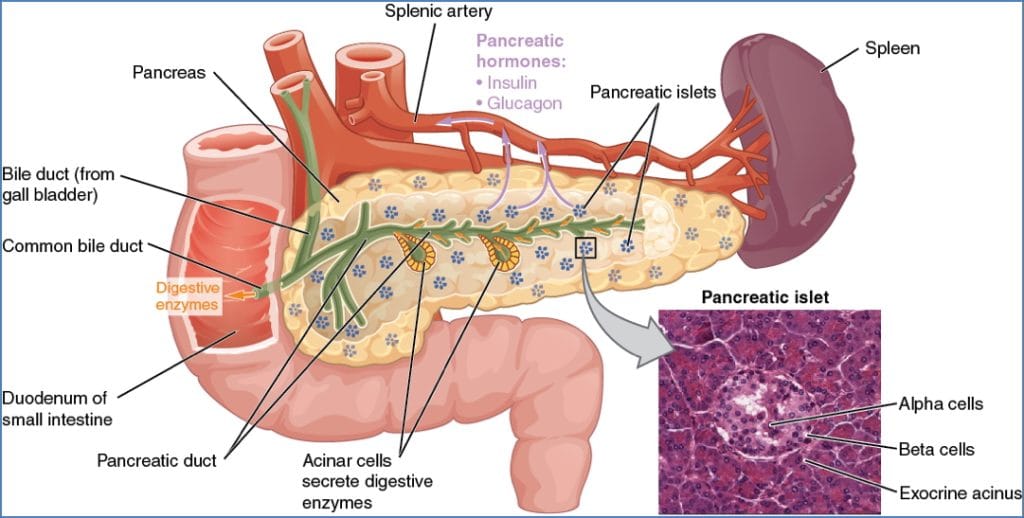
The pancreas is a vital retroperitoneal organ with dual exocrine and endocrine functions. It plays a critical role in digestion through enzyme secretion, as well as in glucose homeostasis through hormone production. Structurally nestled between the duodenum and spleen, its clinical relevance spans from diabetes to pancreatitis to cancer, making it essential for both physiological and pathological understanding.
Anatomy
- Location: Elongated, horizontally oriented, retroperitoneal
- Head: Cupped by the C-shaped curve of the duodenum
- Body: Crosses midline, posterior to the stomach
- Tail: Lies near the hilum of the spleen
Tissue Types
- Exocrine (85%) – Acinar epithelial cells + ductal system
- Endocrine (15%) – Islets of Langerhans scattered throughout
Vascular & Lymphatic Supply
Arterial Supply
- Pancreaticoduodenal arteries (branches of the gastroduodenal and superior mesenteric arteries)
- Splenic artery branches (from the celiac trunk)
Venous Drainage
- Splenic vein → joins superior mesenteric vein → portal vein
Lymphatic Drainage
- Celiac nodes
- Pyloric nodes
- Superior mesenteric nodes
Innervation
- Sympathetic fibres – regulate vasoconstriction and inhibit secretion
- Parasympathetic fibres – via the vagus nerve, stimulate exocrine secretion and insulin release
- Modulated via complex autonomic ganglia and plexuses

Exocrine Function
Pancreatic Acinar Cells
- Specialised epithelial cells that produce digestive enzymes
- Secretion path:
- Enzymes stored in zymogen granules
- Released into intercalated ducts
- Collected into main pancreatic duct → empties into duodenum at the ampulla of Vater
Components of Pancreatic Juice
- Amylase: Carbohydrate digestion
- Lipase: Fat digestion
- Chymotrypsin & Aminopeptidase: Protein digestion
- Elastase: Breaks down elastin (important in meat connective tissue)
- Nucleases: Digest DNA/RNA
- Bicarbonate: Neutralises acidic chyme from stomach
Endocrine Function
Islets of Langerhans
- Groups of hormone-secreting cells scattered among exocrine tissue
Islet Cell Types
- β-cells (Beta):
- Secrete insulin – lowers blood glucose
- α-cells (Alpha):
- Secrete glucagon – raises blood glucose
- δ-cells (Delta):
- Secrete somatostatin – inhibits insulin, glucagon, and GI hormones
- PP-cells (F-cells):
- Secrete pancreatic polypeptide (PP) – regulates satiety and enzyme secretion

Summary – The Pancreas
The pancreas serves crucial exocrine functions via enzyme-rich secretions and endocrine functions through hormone release from the islets of Langerhans. Structurally situated between the duodenum and spleen, it contributes to both digestive processes and metabolic regulation. For a broader context, see our Gastrointestinal Overview page.