
Table of Contents
Overview – Congenital Pancreatic Abnormalities
Congenital pancreatic abnormalities encompass a variety of developmental anomalies involving the fusion, migration, or formation of pancreatic tissue. These include pancreatic divisum, annular pancreas, ectopic pancreatic tissue, and congenital pancreatic cysts. While often asymptomatic, these conditions can lead to complications such as duodenal obstruction, chronic pancreatitis, or in rare cases, malignancy. This article summarises key pathological types, clinical relevance, and diagnostic principles for final-year medical students.
Definition
Congenital pancreatic abnormalities are developmental malformations of the pancreas, resulting in anatomical or functional disruption. They may be incidental findings or associated with significant clinical consequences such as obstruction or inflammation.
Types of Congenital Pancreatic Abnormalities
Pancreatic Divisum
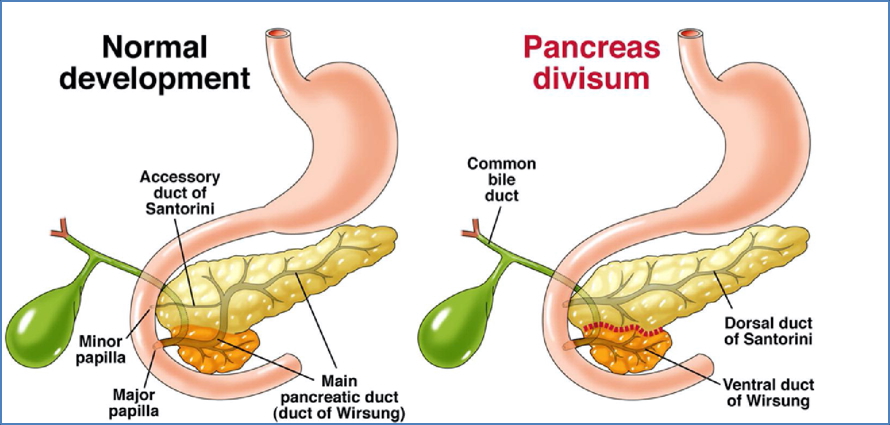
- Failure of fusion between the dorsal and ventral pancreatic ducts.
- Results in:
- Common bile duct draining via the Ampulla of Vater.
- Main pancreatic duct drains via the minor papilla (narrower and shorter).
- Clinical consequence:
- Predisposes to chronic pancreatitis due to restricted outflow through the minor papilla.
Annular Pancreas
- The head of the pancreas encircles the duodenum, forming a ring of tissue.
- This can cause duodenal narrowing or obstruction.
- Presents in neonates or adults with:
- Vomiting (especially bilious in infants)
- Feeding intolerance
- Postprandial fullness

Ectopic Pancreas
- Also called a choristoma: normal pancreatic tissue located outside its usual anatomical site.
- Common sites:
- Stomach
- Duodenum
- Jejunum
- Meckel’s diverticulum
- Usually <1cm in size.
- Typically asymptomatic, but can rarely cause:
- Inflammation
- Bleeding
- Obstruction
- Malignancy (rare)


Pancreatic Cysts (Congenital)
- Fluid-filled cystic lesions within head, body, or tail of pancreas.
- Types:
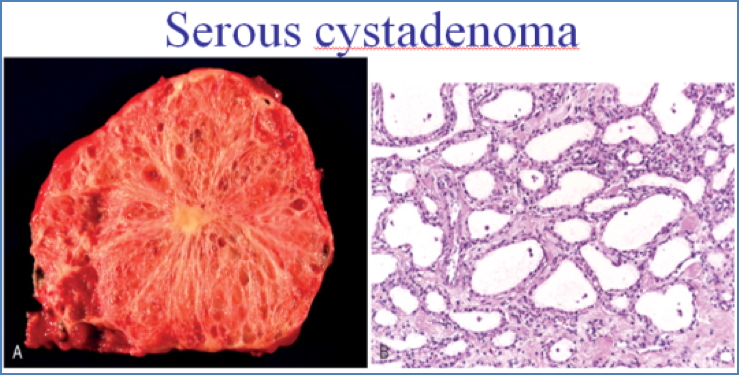
- Serous cystadenoma (usually benign)
- Mucinous cystadenoma (can be precancerous)
- Histology:
- Epithelial-lined cysts
- Contents typically serous or mucinous fluid
- Clinical Features:
- Small cysts: Often asymptomatic
- Large cysts:
- Abdominal or back pain
- Jaundice (if compressing bile duct)
- Duodenal obstruction
- Fever/chills if infected
- Complications:
- Infection
- Compression of nearby structures
- Risk of malignant transformation (especially mucinous)

Investigations
- Imaging:
- Abdominal ultrasound or CT/MRI
- MRCP or ERCP (for pancreatic divisum or annular pancreas)
- Endoscopic ultrasound: Particularly useful for cyst characterisation
- Histology/Biopsy: To determine cyst type or assess for malignancy
Management
- Pancreatic Divisum:
- Conservative in asymptomatic cases
- Endoscopic minor papilla sphincterotomy for recurrent pancreatitis
- Annular Pancreas:
- Surgical bypass (e.g. duodenojejunostomy) if obstructive symptoms
- Ectopic Pancreas:
- Observation if asymptomatic
- Surgical resection if symptomatic or complicated
- Pancreatic Cysts:
- Observation for benign cysts
- Resection if large, symptomatic, or suspicious for malignancy
Summary – Congenital Pancreatic Abnormalities
Congenital pancreatic abnormalities include anatomical variants like pancreatic divisum, annular pancreas, ectopic pancreas, and congenital cysts. While many are asymptomatic, they can cause pancreatitis, obstruction, or carry a risk of malignancy. Imaging and histological assessment guide management decisions. For further insight, visit our Gastrointestinal Overview page.