
Table of Contents
Overview – Conn’s Syndrome
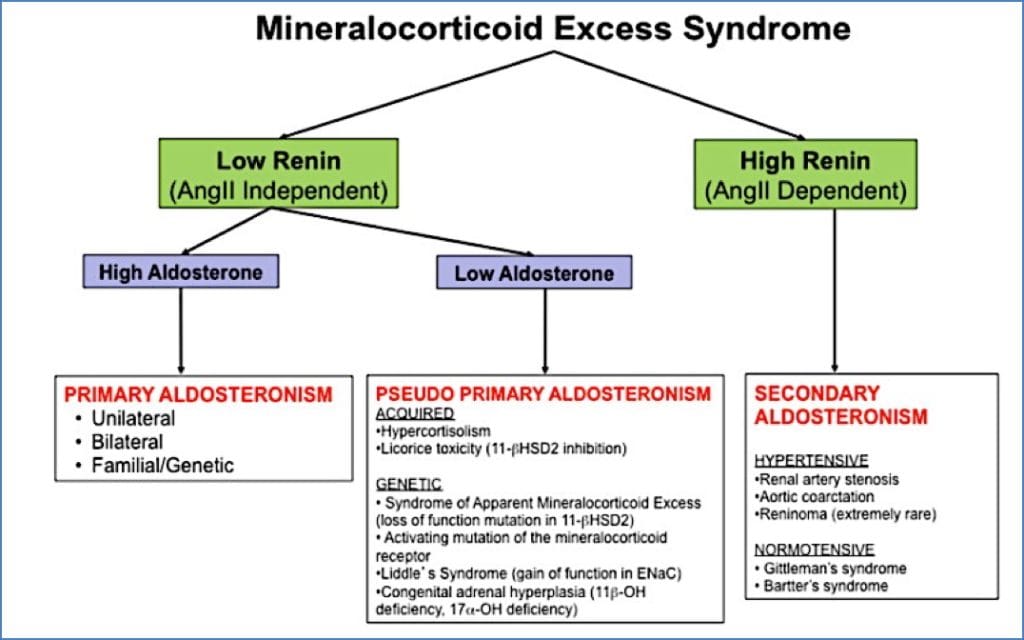
Conn’s Syndrome is the most well-known subtype of primary hyperaldosteronism, a condition caused by autonomous overproduction of aldosterone from the adrenal cortex. This mineralocorticoid excess leads to sodium retention, potassium loss, and systemic hypertension. The syndrome is typically due to an aldosterone-producing adenoma, but may also arise from adrenal hyperplasia or, rarely, carcinoma. Conn’s Syndrome is a potentially curable cause of secondary hypertension and should be considered in any patient with resistant hypertension and unexplained hypokalaemia.
Definition
Conn’s Syndrome refers specifically to primary hyperaldosteronism caused by an aldosterone-producing adenoma of the adrenal cortex. It is one of several causes of primary aldosteronism.
Aetiology
- #1: Idiopathic bilateral adrenal hyperplasia (most common overall cause)
- #2: Aldosterone-producing adenoma (Conn’s Syndrome)
- #3: Aldosterone-producing adrenal carcinoma (very rare)
Pathophysiology
- Aldosterone is produced by the zona glomerulosa of the adrenal cortex
- Excess aldosterone → ↑Na⁺ reabsorption & ↑K⁺ excretion in the kidneys
- Leads to:
- Sodium retention → Hypernatraemia
- Volume expansion → Hypertension
- Potassium loss → Hypokalaemia
Clinical Features
- Universal feature: Hypertension (often resistant to therapy)
- Electrolyte abnormalities:
- Hypernatraemia
- Hypokalaemia → may cause:
- Muscle weakness
- Fatigue
- Constipation
- Cardiac arrhythmias
- May be asymptomatic and only discovered on workup of resistant hypertension or hypokalaemia
Investigations
- Plasma aldosterone concentration (PAC): ↑↑
- Plasma renin activity (PRA): ↓
- Aldosterone-renin ratio (ARR): markedly increased
- Confirmatory testing:
- Saline suppression test or oral sodium loading
- CT adrenal imaging to localise adenoma
- Adrenal vein sampling (if imaging inconclusive or bilateral pathology suspected)
Management
- Conn’s Syndrome (Adenoma):
- Laparoscopic surgical resection of the adenoma is curative
- Idiopathic adrenal hyperplasia:
- Medical management with aldosterone antagonists (e.g. spironolactone, eplerenone)
- Monitor potassium levels and blood pressure
- Lifestyle modifications (e.g. salt restriction, weight control)
Complications
- Cardiovascular disease (due to chronic hypertension)
- Arrhythmias (secondary to hypokalaemia)
- Kidney damage from prolonged hypertension
- Muscle cramps and fatigue (due to electrolyte imbalance)
Summary – Conn’s Syndrome
Conn’s Syndrome is a subtype of primary hyperaldosteronism caused by an aldosterone-producing adrenal adenoma. It leads to hypertension, hypernatraemia, and hypokalaemia. Diagnosis is made by identifying a high aldosterone-renin ratio and confirmed through suppression tests and imaging. Treatment is curative with surgical removal in adenoma cases, while bilateral hyperplasia is managed medically. For more endocrine conditions, visit our Endocrine Overview.