
Table of Contents
Overview – Hemodynamics
Hemodynamics refers to the principles governing blood flow, pressure, and resistance within the circulatory system. It explains how the heart generates pressure, how vessels regulate flow, and how resistance affects tissue perfusion. Mastery of hemodynamic relationships is essential for understanding blood pressure regulation, vascular disease, and cardiac output dynamics.
Flow, Pressure & Resistance
Key Relationships
- Flow is directly proportional to the pressure gradient (ΔP)
- Flow is inversely proportional to resistance
Flow (F) = ΔPressure (ΔP) / Resistance (R)

- The pressure gradient drives flow from high → low pressure
- Resistance opposes flow and is more influential locally than pressure
Blood Flow Rate
- Definition: Volume of blood passing through a vessel, organ, or system per unit time (mL/min)
- Governed by pressure gradient and resistance, not velocity
- Systemic flow = cardiac output (relatively constant)
- Organ-specific flow varies according to metabolic demand (e.g. skeletal muscle during exercise)
Velocity of Blood Flow
- Velocity = speed of blood movement (mm/sec)
- Affected by vessel diameter and cross-sectional area
- In a constricted vessel:
- ↓ Flow rate
- ↑ Velocity (like a garden hose nozzle)
- Key point: Velocity changes more drastically than flow rate in narrow vessels
Blood Pressure
- Force exerted by blood on vessel walls (measured in mmHg)
- Decreases as distance from heart increases
- Influenced by:
- ↓ Blood volume (>10% → ↓ BP)
- ↑ Vessel constriction (with constant volume → ↑ BP)
Resistance to Blood Flow
- Resistance = friction between blood and vessel wall
- Most impactful factor in local flow control
- Three main determinants:
- Blood viscosity (↑ viscosity → ↑ resistance; remains relatively stable)
- Vessel length (↑ length → ↑ resistance; stable in adults)
- Vessel diameter (↓ diameter → ↑ resistance; changes frequently)
Systemic Vascular Resistance (SVR)
- Total resistance in systemic circulation
- SVR is a major determinant of arterial blood pressure
Effects of Vessel Diameter on Flow Rate
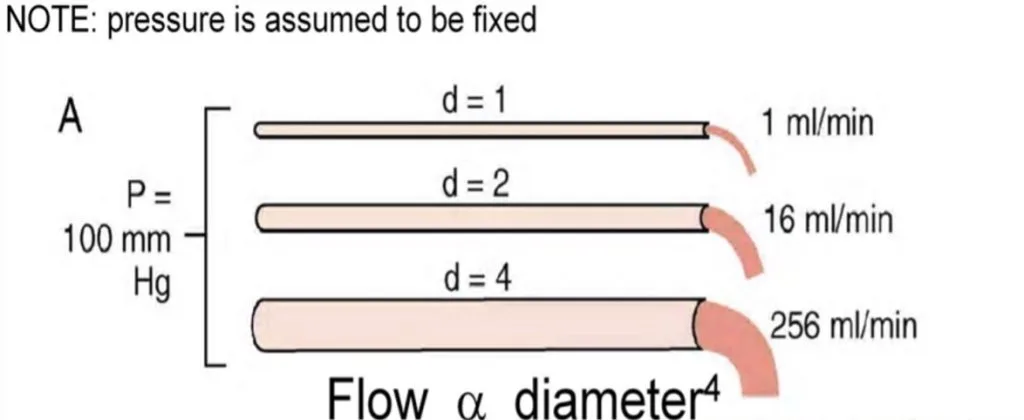
- Flow is proportional to the fourth power of vessel radius
A small change in diameter → large change in flow
- Based on Poiseuille’s Law:
- Doubling diameter increases flow 16-fold
- Halving diameter reduces flow by 94%
Effects of Diameter on Flow Velocity
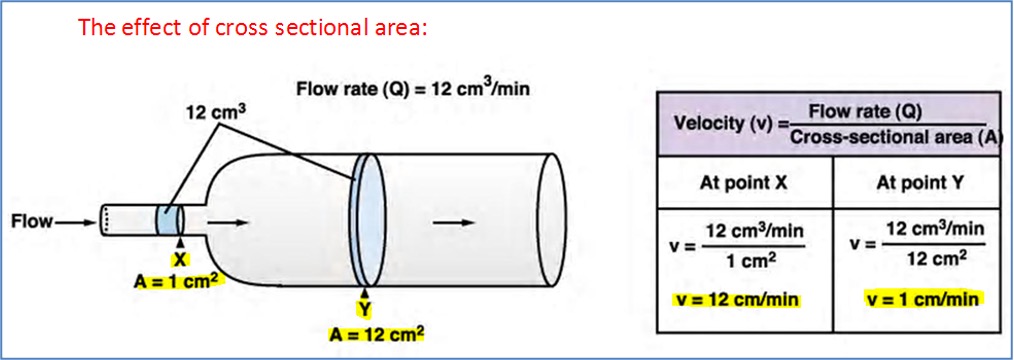
- Velocity is inversely proportional to cross-sectional area
Larger total cross-sectional area → slower flow
- This explains why capillaries (despite small size) have very low velocity
- Allows for efficient nutrient and gas exchange
Summary – Hemodynamics
Hemodynamics describes how blood flow is regulated by pressure gradients and vascular resistance. While flow increases with greater pressure, resistance—especially vessel diameter—plays a more dominant role in local perfusion. These dynamics underlie key clinical concepts like blood pressure regulation and tissue oxygenation. For a broader context, see our Cardiovascular Overview page.