
Table of Contents
Overview – Gas Exchange & Ventilation
Gas exchange and ventilation are fundamental processes of the respiratory system. Gas exchange ensures oxygen uptake from alveoli into the blood and carbon dioxide elimination from blood into the lungs, while ventilation refers to the mechanical movement of air into and out of the lungs. Together, these processes maintain arterial oxygenation and acid–base balance, and their impairment underlies many clinical respiratory conditions.
Path of Oxygen Molecules
- Convection (active, bulk flow): air movement into lungs
- Atmosphere
- Alveoli
- Diffusion (passive): oxygen diffuses into blood
3. Alveolar fluid lining (surfactant)
4. Tissue barrier:- Alveolar epithelium
- Basal lamina
- Interstitium
- Capillary endothelium
- Blood plasma
- Red blood cell membrane
- Uptake by haemoglobin
- Convection: oxygenated blood pumped to systemic circulation
- Diffusion: oxygen diffuses from blood into peripheral cells


Gas Laws
Boyle’s Law:
- At constant temperature, pressure is inversely proportional to volume
- Explains pressure-driven airflow during breathing
- Formula: P1/V1 = P2/V2


Dalton’s Law (partial pressures):
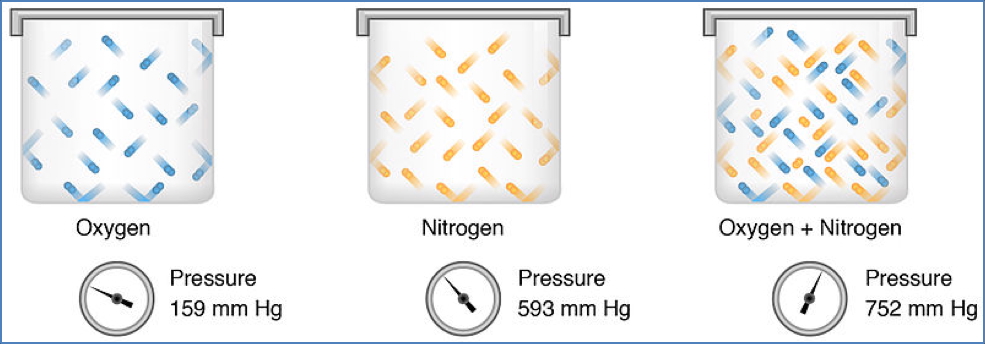
- Total pressure of a gas mixture = sum of partial pressures
- Each gas contributes to pressure in proportion to its abundance
- Example: atmospheric pressure at sea level (760 mmHg) is the sum of partial pressures of nitrogen, oxygen, water vapour, and carbon dioxide

Henry’s Law (dissolved gases):
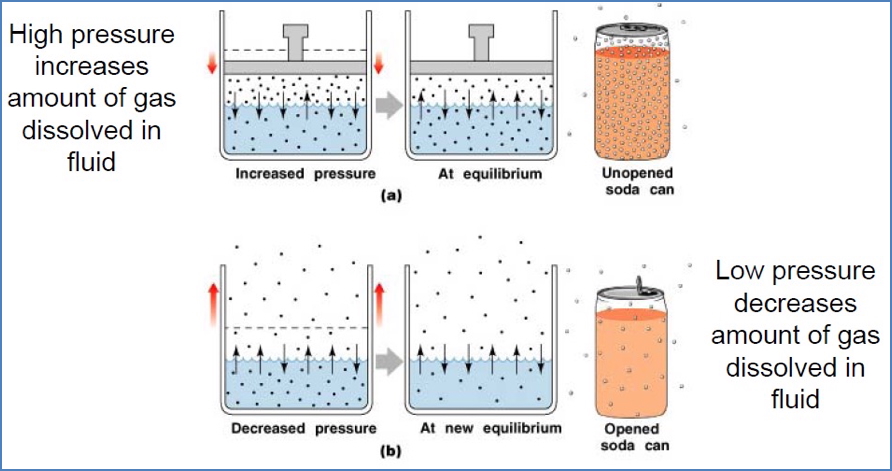
- Gas in solution is proportional to its partial pressure and solubility
- More gas dissolves at higher partial pressure or greater solubility
Fick’s Law (gas diffusion):
- Diffusion increases with:
- Larger surface area
- Thinner membrane
- Greater partial pressure gradient
- Higher diffusion constant (depends on solubility ÷ √molecular weight)
- Implications:
- Lungs maximise alveolar surface area
- Alveolar and capillary basal laminae are fused to minimise thickness
- Clinical relevance:

Pressure Changes During Breathing
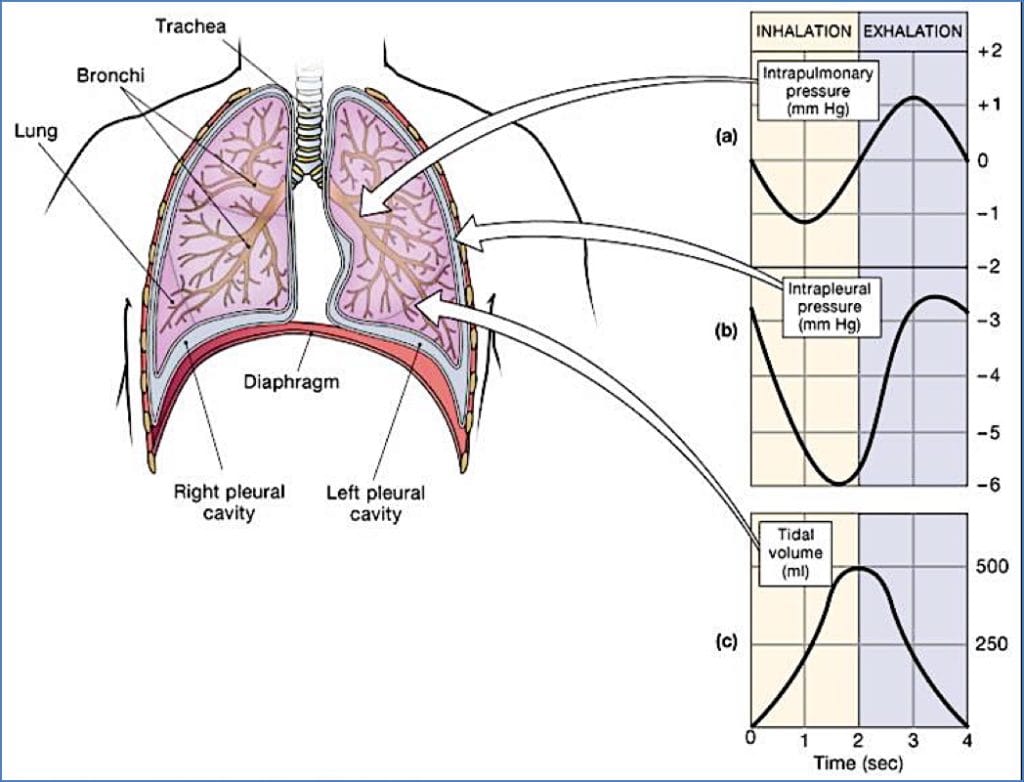
- Intrapleural pressure:
- Negative pressure between visceral and parietal pleura
- Maintained by:
- Elastic recoil of lungs
- Surface tension of alveolar fluid (tends to collapse alveoli)
- Always subatmospheric:
- More negative during inhalation
- Less negative during exhalation
- Secures pleurae together and prevents lung collapse
- Pneumothorax: air in pleural cavity eliminates negative pressure → lung collapse (traumatic or spontaneous)
- Intrapulmonary pressure:
- Pressure within alveoli
- Alternates between negative (inhalation) and positive (exhalation) relative to atmosphere
Mechanics of Breathing
- Inhalation (active):
- Diaphragm contracts and moves inferiorly
- External intercostals contract → ribs move upwards/outwards (bucket-handle and pump-handle)
- Accessory muscles (if forced): scalenes, sternocleidomastoid, pectoralis minor
- Lung volume increases
- Intrapleural pressure becomes more negative
- Intrapulmonary pressure becomes negative relative to atmosphere → air flows in
- Expiration (passive, unless forced):
- Diaphragm relaxes and ascends
- External intercostals relax → rib cage recoils
- Accessory muscles (if forced): abdominal wall muscles, internal intercostals
- Lung volume decreases
- Intrapleural pressure less negative
- Intrapulmonary pressure becomes positive → air flows out

Respiratory Volumes
- Tidal volume (VT): air per normal breath
- Dead space (VD): air in conducting zone not involved in gas exchange
- Expiratory reserve volume (ERV): extra air expired after normal expiration
- Inspiratory reserve volume (IRV): extra air inspired after normal inspiration
- Residual volume (RV): air remaining after maximum forced expiration (not measurable by spirometry)
Respiratory Capacities
- Inspiratory capacity (IC): VT + IRV
- Functional residual capacity (FRC): air left after normal expiration
- Vital capacity (VC): ERV + VT + IRV
- Total lung capacity (TLC): RV + ERV + VT + IRV

Ventilation Metrics and Efficiency
- Respiratory rate (f): breathing frequency
- Minute ventilation (V̇E): tidal volume × frequency
- Alveolar ventilation (V̇A): (tidal volume – dead space) × frequency
- High tidal volume with low frequency = efficient but energy costly
- High frequency with low tidal volume = energy efficient but increases dead space ventilation
Summary – Gas Exchange & Ventilation
Gas exchange and ventilation ensure oxygen uptake, carbon dioxide removal, and acid–base balance. Gas diffusion follows principles described by Boyle’s, Dalton’s, Henry’s, and Fick’s laws, while ventilation relies on intrapleural and intrapulmonary pressure changes driven by muscular activity. Respiratory volumes, capacities, and ventilation efficiency are essential parameters in physiology and clinical medicine. For a broader context, see our Respiratory Overview page.