
Table of Contents
Overview – Kidney Electrolyte Balance
Kidney electrolyte balance is essential for regulating cell function, neuromuscular excitability, and cardiovascular stability. Through selective reabsorption and secretion of ions—particularly sodium and potassium—the kidneys help maintain plasma osmolality, extracellular volume, and normal membrane potentials. This page outlines how the nephron and associated hormonal systems manage electrolyte homeostasis in health and disease.
Why Electrolyte Balance Matters
- Maintains normal cell function
- Preserves chemical stability of extracellular fluid
- Enables activity in excitable tissues (e.g. nerves, cardiac muscle)
- Essential for blood pressure regulation
Key Electrolytes and Their Locations
- Na⁺ (Sodium): High extracellular concentration
- Cl⁻ (Chloride): High extracellular concentration
- K⁺ (Potassium): High intracellular concentration
- Note: Elevated extracellular K⁺ can disrupt cardiac conduction → potentially fatal
Physiological Roles of Electrolytes
- Na⁺:
- Critical for action potentials, cardiac conduction, and cellular transport
- K⁺:
- Vital for muscle contraction and resting membrane potential
- Ca²⁺:
- Important for neuromuscular transmission, cardiac function, and bone health
- Mg²⁺:
- Facilitates acetylcholine release; crucial for neural and cardiac stability
- HPO₄²⁻:
- Contributes to bone structure and acts as a buffer
Sodium Regulation
Aldosterone
- Secreted by: Adrenal cortex
- Stimulated by:
- Angiotensin II
- Hyponatraemia
- Hyperkalaemia
- Stress
- Mechanism of Action:
- Activates Na⁺/K⁺-ATPases in principal cells of the collecting ducts
- Promotes synthesis and insertion of epithelial Na⁺ channels (ENaC)
- Effect:
- ↑ Na⁺ and Cl⁻ reabsorption
- ↑ K⁺ excretion
- ↑ water retention (indirectly, as water follows sodium)
- Regulatory Spectrum:
- High aldosterone → near-total Na⁺ reabsorption
- Low aldosterone → reduced Na⁺ reabsorption

Potassium Regulation
- Primary roles:
- Sets membrane potential
- Essential for nerve, muscle, and cardiac function
- Too little intracellular K⁺ →
- Hyperpolarised cells → ↓ excitability
- Too much intracellular K⁺ →
- Depolarised cells → ↑ excitability
- Cardiac sensitivity:
- Both hyper- and hypokalaemia can cause arrhythmias or cardiac arrest
Renal Control of K⁺
- Principal cells of the collecting ducts:
- Detect blood K⁺ levels
- Adjust secretion accordingly
- ↑ Blood K⁺ → ↑ K⁺ secretion
- ↓ Blood K⁺ → ↓ K⁺ secretion
- Aldosterone Role:
- Stimulated directly by high K⁺
- Enhances Na⁺/K⁺-ATPase activity
- ↑ K⁺ secretion into tubular lumen

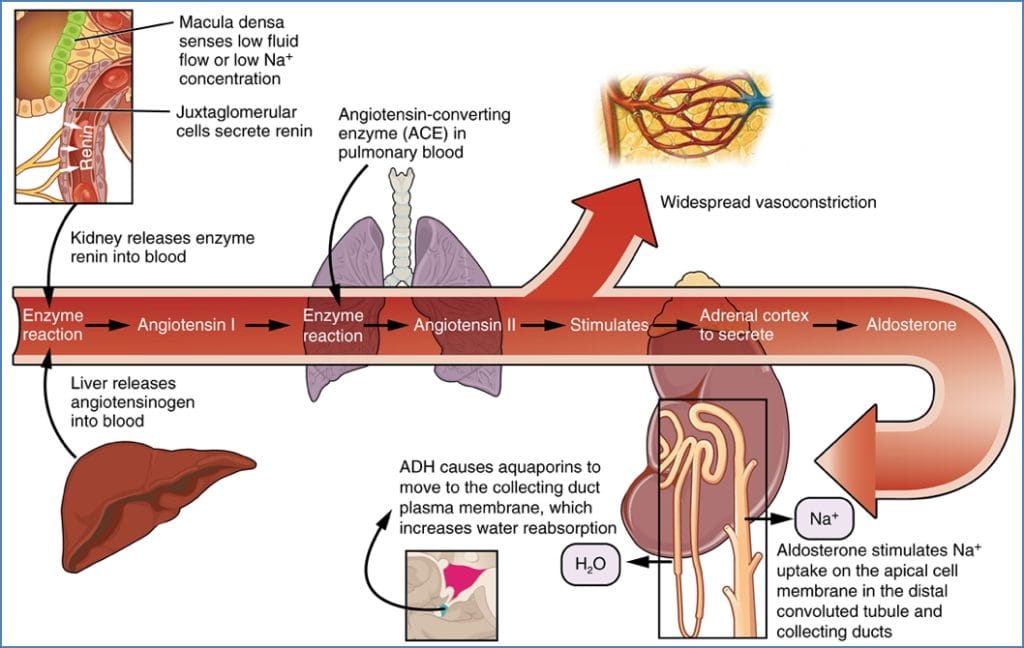
The Renin-Angiotensin System (RAS)
- Function: Regulates extracellular fluid volume and systemic BP
- Juxtaglomerular apparatus (JGA):
- Juxtaglomerular cells (JG cells):
- Mechanoreceptors in afferent arteriole
- Secrete renin in response to:
- Low afferent pressure
- Direct sympathetic stimulation
- Angiotensin II feedback
- Macula densa:
- Modified distal tubule cells
- Detect high tubular osmolality or flow
- Stimulate renin release to reduce GFR
- Juxtaglomerular cells (JG cells):

Effects of Renin
- Initiates conversion of angiotensinogen → angiotensin I → angiotensin II
- Angiotensin II:
- Systemic vasoconstriction → ↑ BP
- Stimulates aldosterone release
- Reduces GFR by vasoconstricting renal arterioles
- Promotes tubuloglomerular feedback → regulates nephron filtration
Summary – Kidney Electrolyte Balance
Kidney electrolyte balance is achieved by tightly regulating sodium and potassium levels through the nephron’s reabsorptive and secretory mechanisms. Aldosterone plays a key role in fine-tuning Na⁺ retention and K⁺ excretion, while the renin-angiotensin system responds to pressure and osmolality changes to maintain systemic homeostasis. For a broader context, see our Renal Overview page.