
Table of Contents
Overview – Normal Labour and Delivery
Normal labour and delivery refers to the natural physiological process that culminates in childbirth, typically occurring between 37 and 41+6 weeks of gestation. It involves complex hormonal triggers and coordinated maternal-fetal adaptations to ensure a safe transition to extrauterine life. Understanding labour’s stages, cervical and fetal variables, and associated processes is critical for monitoring maternal and neonatal wellbeing during childbirth.
Definition
- Labour is defined as regular, painful uterine contractions with progressive cervical dilatation, effacement, and fetal descent.
- False labour (Braxton-Hicks contractions) are irregular, low-intensity contractions with no cervical changes.
Time of Birth
- Preterm: 20 to <37 weeks gestation
- Term: 37 to 41+6 weeks gestation
- Post-term: >42 weeks gestation
- Estimated time of birth is 280 days from the last menstrual period ±15 days.
Foetal Maturation of Organ Systems
- Key systems for extrauterine life include:
- Interface organs: Lungs, gut, immune system
- Homeostatic organs: Endocrine (HPA axis), kidneys, liver, pancreas
- Maturation is promoted by maternal adrenal glucocorticoids, which induce:
- Surfactant production in the lungs
- Enzymatic activity in key tissues (gut, retina, pancreas, thyroid, brain)
- Glycogen deposition in the fetal liver
Initiation of Labour / Parturition
- Triggered by a cascade of hormonal events:
- Oestrogen rises → increases uterotonin receptors (oxytocin & prostaglandins)
- Decreased progesterone effect → uterine irritability → false labour
- Foetal oxytocin triggers placental prostaglandin release
- Maternal stress response activates posterior pituitary to release more oxytocin
- Positive feedback loop leads to strong, regular uterine contractions


Cervical Variables During Labour
- Dilation:
- Latent phase: 0–4 cm
- Active phase: 4–10 cm
- Effacement: Cervical thinning (measured in % or cm)
- Consistency: Firm vs soft
- Position: Posterior, mid, anterior
- Application: Degree of contact between cervix and presenting part
Foetal Variables During Labour
Foetal Lie
- Orientation of fetal spine relative to maternal spine:
- Longitudinal (vertex)
- Transverse
- Oblique

Foetal Presentation
- Fetal part closest to the birth canal:
- Cephalic (vertex/occiput = normal, face, brow)
- Breech (complete, frank, footling)
- Transverse (shoulder)
- Compound (extremity prolapses with presenting part)
- Only vertex presentation is considered normal.
Foetal Position
- Relationship of presenting part to maternal pelvis:
- Occiput anterior (OA) – most common and favourable
- Occiput posterior (OP) – may cause prolonged labour
- Occiput transverse (OT) – risk of arrest if failure to rotate to OA

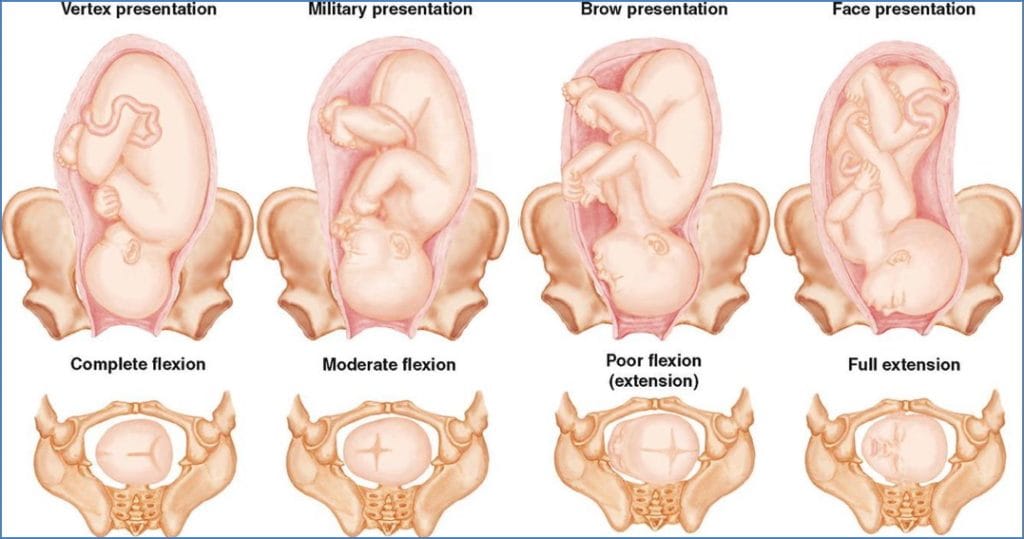
Attitude
- Degree of flexion/extension of fetal head relative to body:
- Flexed (normal)
- Brow presentation – partial extension → requires caesarean
- Face presentation – full extension; vaginal birth only possible if mentum anterior
Station
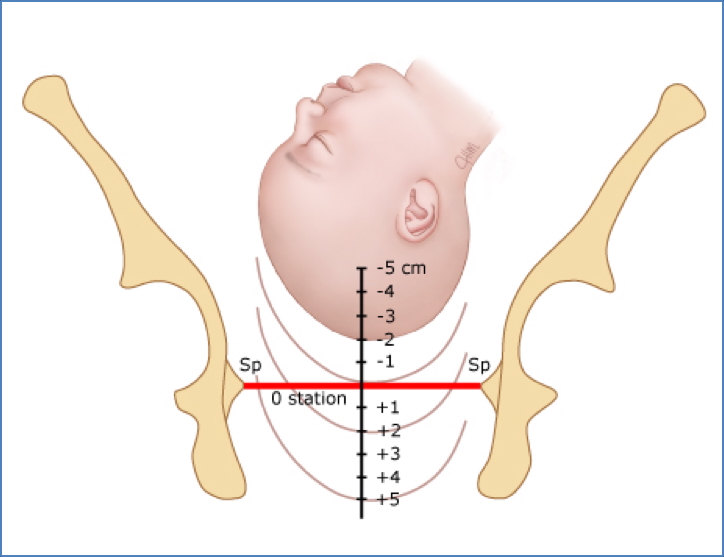
- Descent of presenting part relative to ischial spines:
- 0 = engaged
- -5 to -1 cm = above spines
- +1 to +5 cm = below spines
Stages of Labour
Stage 1: Dilation Stage
- From onset of regular contractions to full cervical dilation (10 cm)
- Duration: 6–12 hours
- Features:
- Contractions intensify and become coordinated
- Amniotic sac often ruptures
- Cervix softens, effaces, and dilates
- Fetal head rotates to accommodate pelvic dimensions

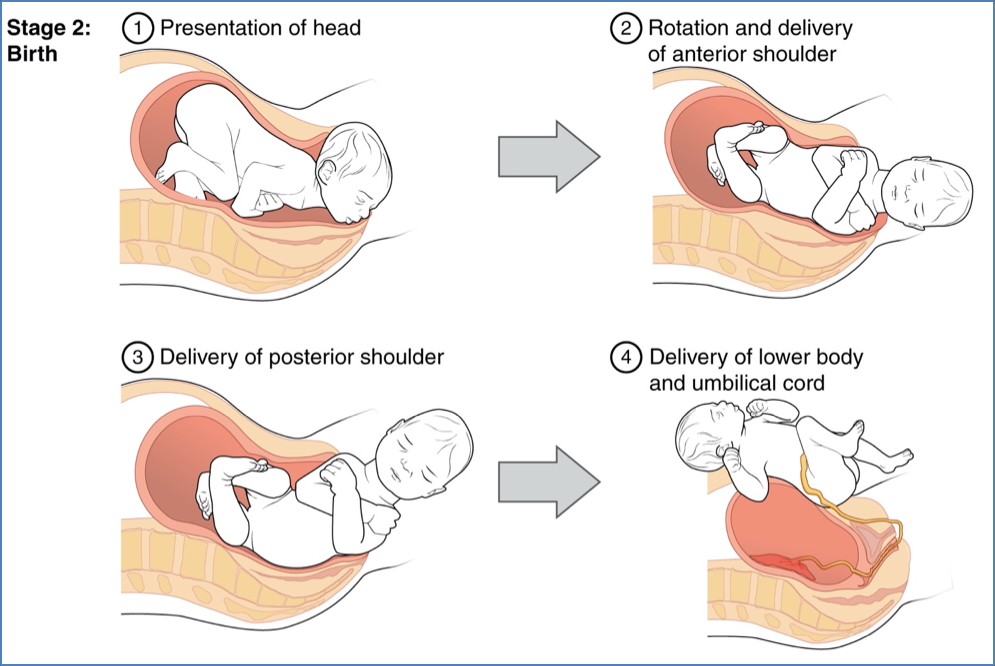
Stage 2: Expulsion Stage
- From full dilation to delivery of the baby
- Duration: ~1 hour on average
- Features:
- Strong contractions every 2–3 minutes
- Vertex delivery (head-first):
- Crowning followed by full delivery
- Umbilical cord clamped and cut
- Breech delivery:
- More complex, often requiring assistance or caesarean
Stage 3: Placental Stage
- Delivery of placenta (~30 minutes after birth)
- Breastfeeding soon after birth stimulates oxytocin → promotes uterine contraction
- Routine oxytocin reduces postpartum haemorrhage by over 40%

Summary – Normal Labour and Delivery
Normal labour and delivery is a hormonally coordinated, multistage process leading to birth, typically between 37 and 42 weeks. It is defined by regular, painful uterine contractions, cervical dilation, and progressive descent of the fetus. Monitoring cervical and fetal variables is key to safe delivery. For more, see our Obstetrics Overview page.