
Table of Contents
Overview – Maternal Adaptations to Pregnancy
Maternal physiologic adaptations to pregnancy involve coordinated changes across nearly every organ system to support the developing fetus and prepare for labour. These changes are hormonally mediated and affect the cardiovascular, respiratory, renal, endocrine, gastrointestinal, and reproductive systems. Understanding these adaptations is crucial for interpreting normal vs. pathological findings during antenatal care.
Reproductive System Changes
- ↑ Vascularity and size of reproductive organs.
- Chadwick’s sign: Purplish hue of vaginal mucosa.
- Breasts enlarge and areolae darken.
- Placenta secretes relaxin → loosens pelvic ligaments and pubic symphysis.
- Human chorionic somatomammotropin (hCS):
- Promotes breast maturation.
- Increases maternal insulin resistance → glucose-sparing for fetus → may contribute to gestational diabetes.
- Uterus enlarges:
- Displaces abdominal and thoracic organs.
- Causes rib flaring and elevated diaphragm.
Urinary System Changes
- Bladder compression → ↓ capacity → ↑ frequency.
- Smooth muscle relaxation (via progesterone) → ↓ sphincter tone → stress incontinence and ↑ risk of UTIs.
- ↑ GFR (~50%) due to plasma volume expansion:
- Promotes polyuria and loss of ions.
- Aldosterone compensates by enhancing sodium/water reabsorption.
- Glycosuria may occur as filtration exceeds tubular reabsorption.
- Ureters dilate and lengthen due to progesterone.
Respiratory System Changes
- ↑ Oxygen consumption (~20%).
- Progesterone:
- Increases sensitivity of respiratory centres to CO₂.
- Leads to ↑ tidal volume and minute ventilation (functional tachypnoea).
- Diaphragm:
- Rises ~4 cm → ↓ total lung capacity.
- Thoracic adaptations:
- ↑ rib flaring (thoracic diameter ↑ by 6–10 cm).
- ↑ use of accessory muscles.
- ABG parameters unchanged: PaO₂ and PaCO₂ remain stable.
Cardiovascular System Changes
- ↑ Total body water and plasma volume (by 25–40%):
- Supports placental perfusion and buffers blood loss during delivery.
- ↑ Cardiac output due to:
- ↑ Heart rate.
- Hyperdynamic circulation → may cause physiological systolic murmur.
- Uterine pressure on iliac veins:
- ↓ Venous return from legs.
- Contributes to varicose veins, haemorrhoids, and leg oedema.
Haematological System Changes
- Haemodilution:
- Plasma volume ↑ > red cell mass → physiological anaemia.
- Hypercoagulability:
- ↑ Clotting factors and ↓ antithrombin-III → ↑ risk of DVT/PE.
- Leukocytosis:
- ↑ WBC count but functional suppression → relative immunodeficiency.
- Gestational thrombocytopenia due to increased consumption.
Gastrointestinal System Changes
- Morning sickness: Driven by ↑ oestrogen and progesterone.
- Heartburn and reflux:
- Progesterone ↓ oesophageal sphincter tone.
- Uterine pressure on stomach.
- Constipation:
- ↓ Bowel motility (progesterone) + rectal compression.
- GI displacement:
- Important in differential diagnosis (e.g. appendix shifts upward → right flank pain).
- Salivation increases: Helps prevent ulcers and tooth decay.
- Stomach:
- ↓ Gastric acid and motility.
- ↑ Aspiration risk under anaesthesia.
- Liver:
- No size change, but ↑ metabolic workload.
- Only alkaline phosphatase increases (placental origin).
- Gallbladder:
- ↓ Contraction (progesterone) → bile stasis → ↑ gallstone risk.
Endocrine System Changes
Pancreas
- ↑ Insulin secretion to counteract insulin resistance.
- Insulin resistance due to:
- hCS (human placental lactogen)
- Cortisol, progesterone
- Ensures maternal hyperglycaemia for fetal use.
Note: Maternal insulin does not cross the placenta; fetus produces its own insulin.
Thyroid
- hCG mimics TSH → stimulates thyroid.
- ↑ Size and hormone production but normal T₃/T₄ due to ↑ thyroid-binding globulin.
- Human chorionic thyrotropin (hCT): Increases metabolism and calcium availability for fetal bone mineralisation.
Parathyroid
- ↑ PTH → ↑ maternal bone resorption → ↑ serum calcium for fetus.
Adrenal Glands
- ↑ ACTH:
- ↑ Aldosterone → sodium and water retention → oedema.
- ↑ Cortisol → contributes to immunosuppression.
Pituitary Gland
- ↑ Prolactin: Prepares breasts for lactation.
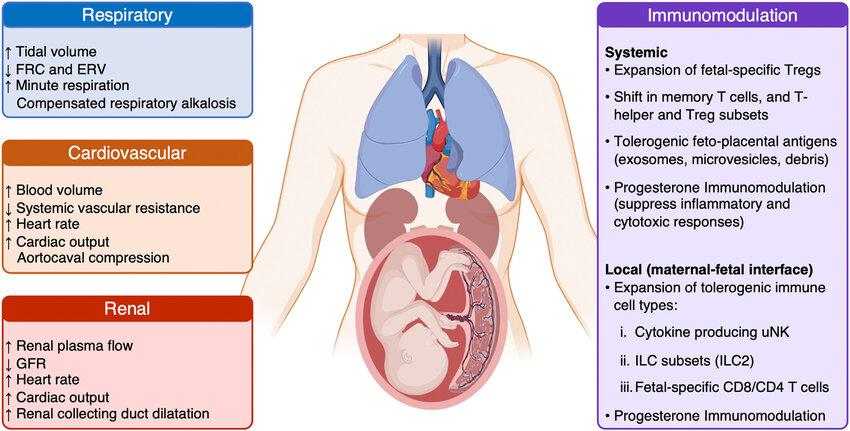
Summary – Maternal Adaptations to Pregnancy
Maternal adaptations to pregnancy involve complex hormonal and structural changes to support fetal growth and prepare the body for childbirth. These include cardiovascular expansion, renal compensation, respiratory changes, endocrine alterations, and gastrointestinal adaptation. For a broader context, see our Obstetrics Overview page.