
Table of Contents
Overview – Tongue & Gustation
The tongue plays a key role in mastication, speech, and, critically, gustation — the sensory modality of taste. Taste is mediated by chemoreceptors primarily housed in taste buds on the tongue. Understanding this system is vital in clinical neurology, ENT, and nutrition, particularly when assessing cranial nerve function or changes in appetite and food tolerance in systemic illness.
Receptor Type
- Chemoreceptors – Respond to dissolved chemical substances.
Location of Taste Buds
- Found primarily in the oral cavity, especially on:
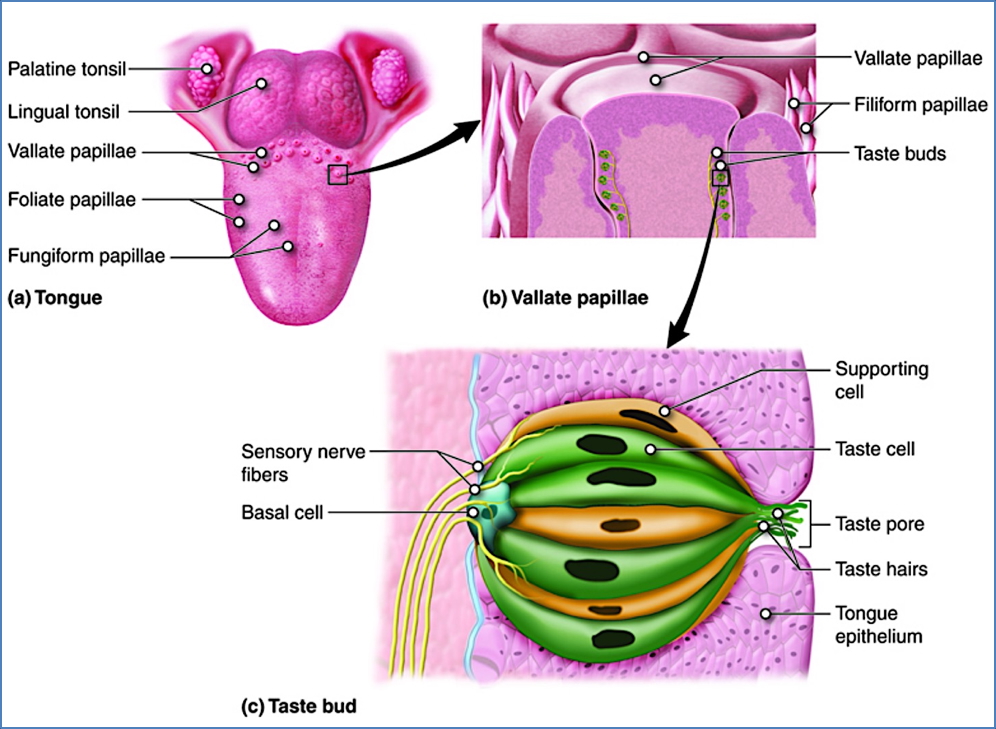
- Fungiform papillae (anterior tongue)
- Circumvallate papillae (posterior tongue sidewalls)
- Also present on:
- Soft palate
- Inner cheeks
- Pharynx
- Epiglottis
Structure of Taste Buds
Each taste bud = 50–100 epithelial cells:
- Supporting Cells:
- Insulate and support receptor cells
- Receptor (Gustatory) Cells:
- Apical microvilli = gustatory hairs → project through taste pore
- Contact with tastants → neurotransmitter release
- Innervated by facial, glossopharyngeal, or vagus nerve fibres
- Basal Cells:
- Act as stem cells
- Replace receptor cells every 7–10 days
Basic Taste Sensations
- Sweet → sugars, amino acids, lead salts
- Sour → acids (H⁺ ions)
- Salty → Na⁺ and other metal ions
- Bitter → alkaloids (quinine, nicotine, caffeine)
- Dislike is protective — many toxins are bitter
- Umami → glutamate, MSG (savory/meaty)
Taste Significance:
- Sweet → carbs & minerals
- Salt → electrolytes
- Sour → vitamin C (e.g. citrus)
- Umami → protein sources
- Bitter → poison avoidance
Physiology of Taste
- Tastants must:
- Dissolve in saliva
- Diffuse through taste pore
- Contact gustatory hairs
- This binding triggers a receptor potential → neurotransmitter release → cranial nerve activation → action potentials to CNS
Taste Transduction
Mechanism varies by taste type:
- Salty: Na⁺ influx → depolarisation
- Sour: H⁺ entry or K⁺ channel inhibition
- Bitter, Sweet, Umami:
- G-protein-coupled receptors
- Activate second messenger → ↑ intracellular Ca²⁺ → neurotransmitter release
Gustatory Pathway
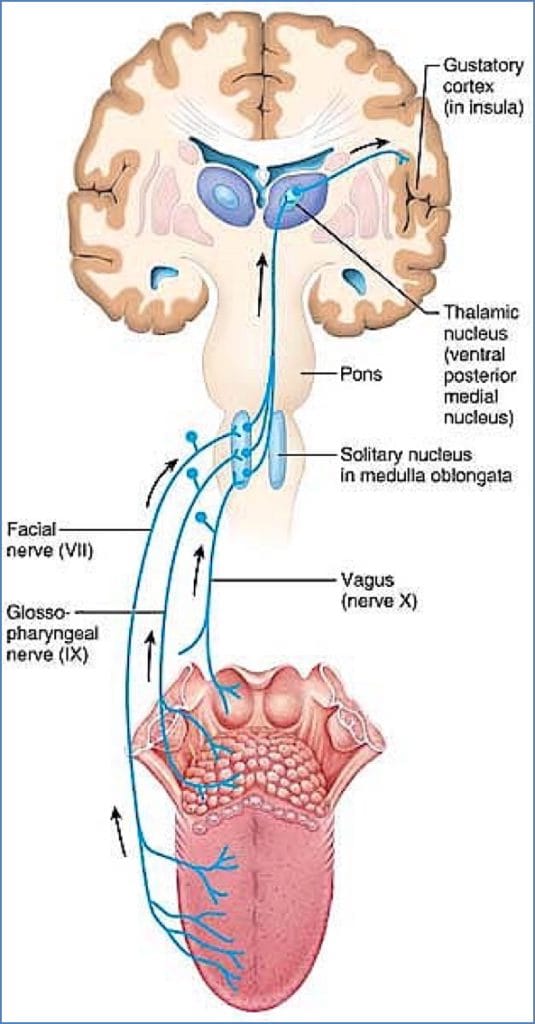
- Afferent cranial nerves:
- Facial nerve (CN VII) → anterior 2/3 of tongue
- Glossopharyngeal nerve (CN IX) → posterior 1/3
- Vagus nerve (CN X) → epiglottis & lower pharynx
- Pathway:
Taste buds → Solitary nucleus (medulla) → Thalamus → Gustatory cortex (Parietal lobe)
Summary – Tongue & Gustation
The sense of taste is mediated by chemoreceptors located in taste buds on the tongue and oral cavity, with input conveyed via cranial nerves VII, IX, and X to the gustatory cortex. Each basic taste has a unique transduction mechanism, and taste perception plays an essential homeostatic and protective role.
For a broader context, see our Nervous System Overview page.