Cerebrovascular Accidents

Overview – Cerebrovascular Accidents

Cerebrovascular accidents (CVAs) encompass a spectrum of cerebrovascular conditions that impair blood flow to the brain. These include transient ischaemic attacks (TIAs), evolving or completed strokes, and haemorrhagic bleeds, each with distinct clinical profiles but overlapping risk factors and investigations. Final-year students must confidently distinguish these presentations and know when urgent interventions like thrombolysis or anticoagulation are indicated.


Definition

TermDefinition
TIA (Transient Ischaemic Attack)Temporary focal cerebral ischaemia without infarction; resolves within 24 hours.
CVA (Cerebrovascular Accident)Brain ischaemia lasting >24 hours due to vascular causes. Can be ischaemic or haemorrhagic.
Stroke (Clinical Syndrome)Rapid loss of brain function due to interruption in blood supply. Stroke is the clinical manifestation of a CVA.

Transient Ischaemic Attack (TIA)

Definition

  • Brief neurological dysfunction from temporary focal cerebral ischaemia without infarction
  • Symptoms resolve within 24 hours
  • Often described as a “mini-stroke”

Aetiology

  • Thromboembolism (usually transient)
    • From carotid atheroma
    • Cardioembolic: AF, valve disease, mural thrombus, prosthetic valves

Pathophysiology

  • Temporary blockage of a cerebral artery → ischaemia
  • Reperfusion occurs before infarction → reversible symptoms
  • Prolonged ischaemia leads to infarct → stroke

Morphology

  • No infarction
  • Only metabolic/functional changes (no structural damage)

Clinical Features

Location AffectedSymptoms
Cerebral hemisphereContralateral hemiplegia
BrainstemCranial nerve signs, quadriplegia, visual disturbances
Lacunar region (basal ganglia)Pure motor/sensory deficits
Retinal artery embolismAmaurosis fugax (transient monocular blindness)

Differential Diagnosis

Investigations

  • Examination: BP, carotid bruit, murmurs, fundoscopy, ECG (AF?)
  • Bloods: FBC, U&Es, ESR, glucose, lipids
  • Imaging:
    • CT Brain (exclude haemorrhage)
    • Carotid Doppler ± angiography

Management

  • Risk Factor Control:
  • Anticoagulation (if cardioembolic): Warfarin ± heparin cover
  • ± Carotid Endarterectomy (if significant stenosis)

Ischaemic Strokes

Definition

  • Vascular event leading to persistent neurological deficit (>24 hours)
  • Includes evolving or completed ischaemic strokes

Clinical Types

SubtypeDescriptionTypical Cause
Evolving CVANeurological deficit progressively worsening over >24hThrombosis
Completed CVAStable, non-evolving deficitEmbolism

Aetiology

CauseExamples
Thrombotic (50%)Atherosclerosis rupture, hypercoagulable state (e.g. OCPs)
Embolic (30%)AF, mural thrombus, carotid atheroembolism, paradoxical emboli

Pathophysiology

  • Vessel occlusion → focal ischaemia
  • Neuronal infarction → permanent deficits
  • Most commonly affects MCA, then ACA, then PCA

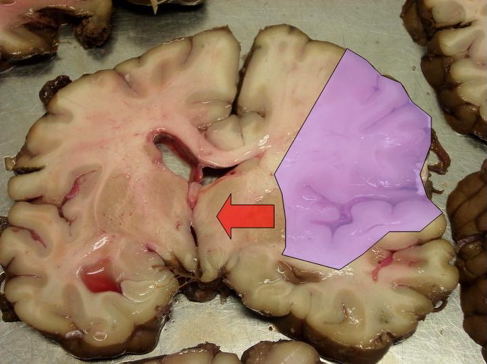
Morphology

  • Early: oedema, flattened gyri, narrow sulci
  • ~1 week: liquefactive necrosis, cavitation
  • Thrombolysis may cause petechial haemorrhages

Clinical Features

TerritorySigns
MCA (most common)Contralateral hemiplegia (face/arm > leg), sensory loss, homonymous hemianopia, expressive aphasia (if dominant hemisphere)
ACAContralateral leg weakness, abulia, flat affect, frontal lobe signs
PCAVisual deficits, memory loss, alexia without agraphia (if left-sided)

Investigations

  • Clinical exam
  • ECG (AF?)
  • Bloods: FBC, coags, lipids
  • CT Brain (rule out haemorrhage)
  • MRI Brain (higher resolution)

Management

  • Supportive: Fluids, O₂, BSL monitoring
  • Acute Treatment:
    • IV tPA (within 4.5 hrs)
    • Thrombectomy (if large vessel occlusion)
  • Secondary Prevention:
    • Aspirin or clopidogrel
    • Anticoagulation (if cardioembolic)
    • Rehabilitation: speech, physio, OT

Prognosis

  • Mortality ~40%
  • Long-term morbidity: hemiplegia, aphasia, dementia, seizures

Haemorrhagic Stroke

Definition

  • Bleeding into brain parenchyma or surrounding spaces, leading to raised ICP and ischaemia

Aetiology

CauseDetails
HypertensionChronic → vessel rupture → intracerebral haemorrhage
AV MalformationsCongenital → rupture → bleeding into brain tissue
Aneurysmse.g. Berry aneurysm → SAH
TraumaExtradural (arterial) or subdural (venous) haemorrhage

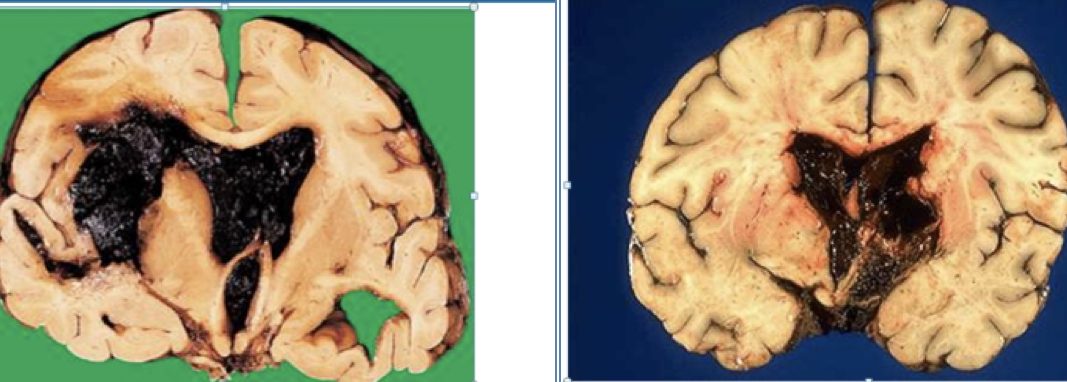
Morphology

  • Slit haemorrhages: Microbleeds that scar
  • Lacunar infarcts: Pale, cavity-like lesions in brainstem
Hypertensive stroke, Lacunar infarct

Clinical Features

  • Sudden headache, vomiting, meningism
  • Anisocoria, nystagmus, focal neurological deficits
  • Signs of raised ICP: hypertension, bradycardia, Cheyne-Stokes
  • ALOC, herniation (uncal, tonsillar, subfalcine)

Investigations

  • CT or MRI Brain: Confirms bleeding site and size
  • Transcranial Doppler (AVM assessment)

Management

  • Supportive: Airway, fluids
  • Medical:
    • BP control (β-blockers, ACEi, CCBs)
    • Mannitol (↓ICP), corticosteroids
    • rFVIIa, FFP, Vitamin K (if coagulopathy)
  • Surgical: Evacuation if haematoma >3cm or signs of herniation

Prognosis

  • 40% mortality
  • 75% of survivors have lasting disability

Summary – Cerebrovascular Accidents

Cerebrovascular accidents include transient ischaemic attacks, evolving or completed ischaemic strokes, and haemorrhagic strokes. Each type has unique causes and management strategies, with ischaemic strokes dominating in prevalence. Early recognition, imaging to rule out haemorrhage, and rapid intervention can significantly impact outcomes. For a broader context, see our Nervous System Overview page.

Shopping Cart
Scroll to Top