
Table of Contents
Overview – Cell Adhesion Molecules
Cell adhesion molecules are key surface proteins that mediate the movement of immune cells throughout the body. They play a vital role in both routine lymphocyte circulation and the targeted migration of white blood cells (WBCs) to sites of infection or inflammation. Understanding their role is essential for grasping how immune surveillance and inflammatory responses function, as well as for recognising clinical conditions such as leukocyte adhesion deficiency.
Definition
Cell adhesion molecules (CAMs) are glycoproteins expressed on the surface of immune cells and vascular endothelium. They mediate:
- Lymphocyte circulation through blood and lymphoid tissues
- Leukocyte migration and homing to sites of infection or injury
Types of Cell Adhesion Molecules
- Selectins (e.g. L-Selectin, E-Selectin)
- Integrins (e.g. LFA-1)
- Immunoglobulin Superfamily CAMs (e.g. ICAM-1)
- Addressins (e.g. GlyCAM-1)
- Chemokines (e.g. IL-8)
Routine Lymphocyte Circulation
Goal: Ensure Naive T-cells continuously circulate and screen for antigens.
Pathway: Blood → Lymph Node → Blood
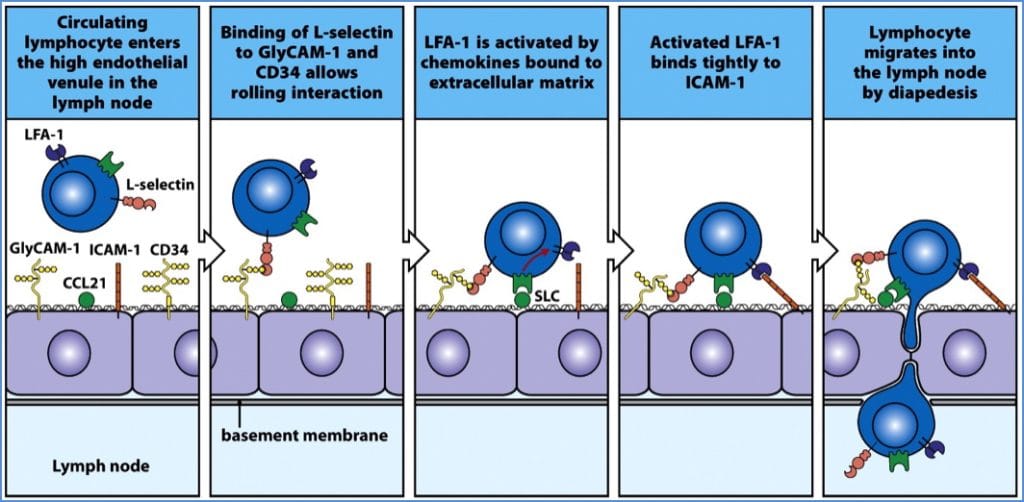
- Naive T-cells exit blood via High Endothelial Venules (HEVs) in lymph nodes
- HEV endothelium expresses:
- GlyCAM-1 (binds L-selectin on T-cell)
- ICAM-1
- Membrane-bound chemokines
- Sequence of Events:
- L-selectin binds GlyCAM-1 → Initial contact
- Chemokines trigger LFA-1 to tightly bind ICAM-1 → Arrest
- Diapedesis into lymph node
- In lymph nodes:
- Naive T-cells scan dendritic cells
- Activated T-cells proliferate into Effector CD4/CD8 T-cells
- CD4 T-cells help B-cells → antibody production
- CD8 T-cells re-enter circulation via efferent lymph → thoracic duct → vena cava
Note: Most lymphocytes in peripheral blood are T-cells, but they represent only ~2% of the total lymphocyte population.
Migration & Homing of WBCs to Tissue
Goal: Recruit activated immune cells to fight infection/injury.
Pathway: Blood → Infected Tissue
- Triggered by Leukocytosis-inducing factors from injured cells
- Endothelial activation results in expression of:
- E-selectin
- ICAM-1
- Chemokines (e.g. IL-8)
Sequence of Events:
- Rolling:
- Leukocyte E-selectin binds Sialyl-Lewis X (S-LeX) on leukocyte
- Activation:
- IL-8 binds leukocyte receptors
- Triggers LFA-1 conformational change
- Adhesion:
- Tight binding of LFA-1 to ICAM-1 arrests the cell
- Diapedesis:
- Cell migrates across endothelium
- Chemotaxis:
- Follows IL-8 gradient to infection
- Monocyte maturation:
- Monocytes → Macrophages in tissue


Clinical Correlation: Leukocyte Adhesion Deficiency
- Caused by defect in β2 chain of LFA-1
- Impairs tight binding to ICAM-1
- Leads to:
- Recurrent bacterial infections
- Delayed wound healing
- Impaired inflammatory cell recruitment
Summary – Cell Adhesion Molecules
Cell adhesion molecules are essential mediators of immune cell circulation and migration. They facilitate lymphocyte homing to lymph nodes and the recruitment of white blood cells to infection or injury sites via rolling, adhesion, diapedesis, and chemotaxis. Disruptions in CAMs can lead to serious immunodeficiency disorders like leukocyte adhesion deficiency. For a broader context, see our Immune & Rheumatology Overview page.