
Table of Contents
Overview
Antigens are molecules that can bind specifically to immune receptors, such as antibodies, B cell receptors (BCRs), or T cell receptors (TCRs). While not all antigens trigger an immune response, those that do are termed immunogens. Understanding the properties and classifications of antigens is fundamental to immunology, vaccine development, and autoimmune disease pathology.
Definition
- Any molecule that specifically binds to an antibody, B cell receptor (BCR), or T cell receptor (TCR)
- Named for their antibody-generating potential
- Not all antigens provoke an immune response:
- Immunogens = antigens that elicit an immune response
- Self-antigens = typically tolerated; may cause autoimmunity if tolerance fails
Antigenicity
Antigenicity refers to the degree to which an antigen is recognised and bound by antibodies or TCRs. Influencing factors include:
- ↑ Antigen size
- ↑ Molecular complexity
- ↑ Foreignness (non-self)
- ↑ Dose of antigen
- ↑ Route of administration (which influences secondary lymphoid organ engagement)
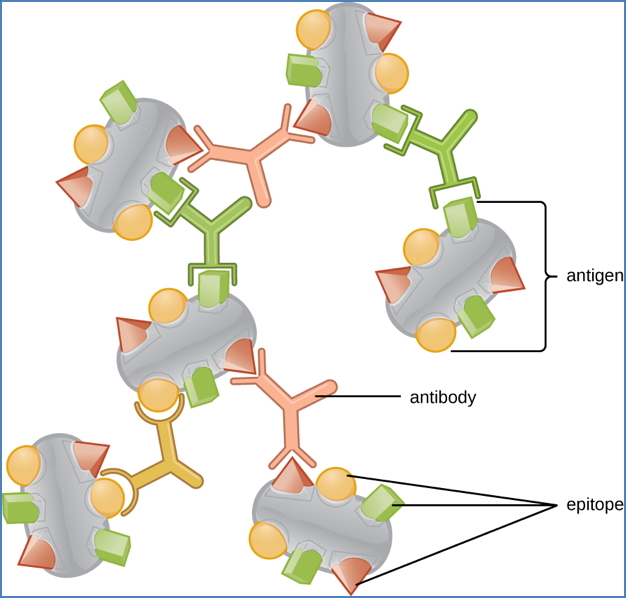
Epitopes
- An antigen contains multiple epitopes — specific molecular regions that can each independently trigger an immune response
- Each epitope can bind to a unique BCR, TCR, or antibody
- Critical in vaccine design and monoclonal antibody therapy
Thymus-Dependent Antigens
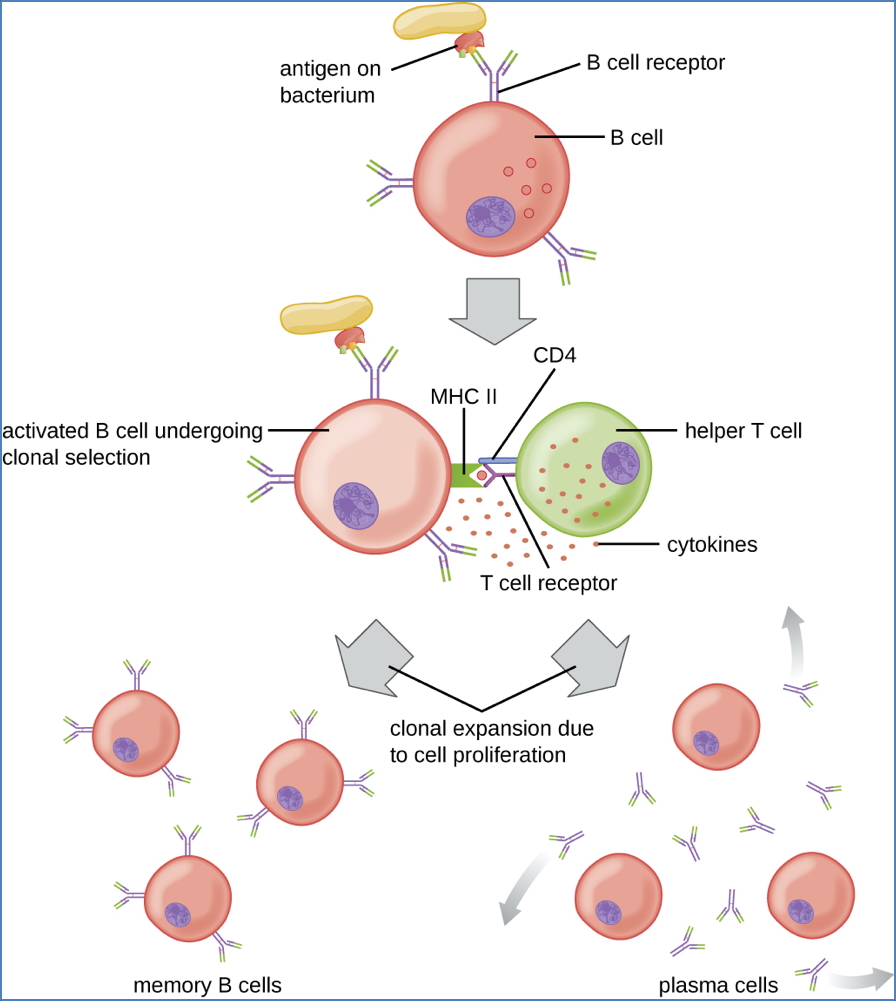
- Require CD4+ Helper T cell involvement for full B cell activation
- B cell internalises antigen → presents it via MHC-II → recognised by CD4+ T cell
- T cell secretes cytokines → activates B cell → plasma cell → antibody production
Thymus-Independent Antigens
- Can directly activate B cells without T cell help
- Often large polysaccharide structures (e.g., bacterial capsules)
- Typically induce a weaker immune response and poor memory formation

Superantigens
- Produced by certain bacteria and viruses
- Bind non-specifically to MHC and TCRs, bypassing normal antigen processing
- Trigger massive, polyclonal T cell activation → maladaptive → cytokine storm
- Associated with conditions like toxic shock syndrome

Common Antigens
Bacterial –
- Flagellin
- Capsule polysaccharides
- Cell wall components
- Endotoxins and exotoxins
- (Often share features with Pathogen-Associated Molecular Patterns [PAMPs])
Viral –
- Capsid proteins
- Envelope glycoproteins
- Nucleoproteins
Self –
- Red blood cell antigens (A, B, Rhesus D)
- Major Histocompatibility Complex (MHC) molecules – MHC-I & MHC-II
- Clusters of Differentiation (CD markers) – e.g., CD4, CD8, CD40

Summary
Antigens are molecules capable of binding specifically to immune receptors and may trigger a targeted immune response. Their immunogenicity depends on features such as size, complexity, and foreignness. Key types include thymus-dependent, thymus-independent, and superantigens, each activating different arms of the immune system. For a broader context, see our Immune & Rheumatology Overview page.