
Table of Contents
Overview – Gilbert’s Syndrome
Gilbert’s syndrome is a common, benign inherited liver condition that leads to mild unconjugated hyperbilirubinaemia. It is caused by a genetic deficiency in the enzyme responsible for bilirubin conjugation, leading to intermittent jaundice—often triggered by fasting, illness, or stress. As it is asymptomatic and not associated with liver damage, it is typically discovered incidentally during routine blood tests. Understanding Gilbert’s syndrome is important in clinical practice to distinguish it from pathological causes of jaundice and avoid unnecessary investigations.
Definition
Gilbert’s syndrome is a benign, inherited disorder characterised by intermittent unconjugated hyperbilirubinaemia due to reduced activity of the enzyme UDP-glucuronosyltransferase, involved in bilirubin conjugation.
Aetiology
- Genetic/familial condition
- Autosomal recessive inheritance
- Mutation in the UGT1A1 gene encoding bilirubin-conjugating enzyme
Pathogenesis
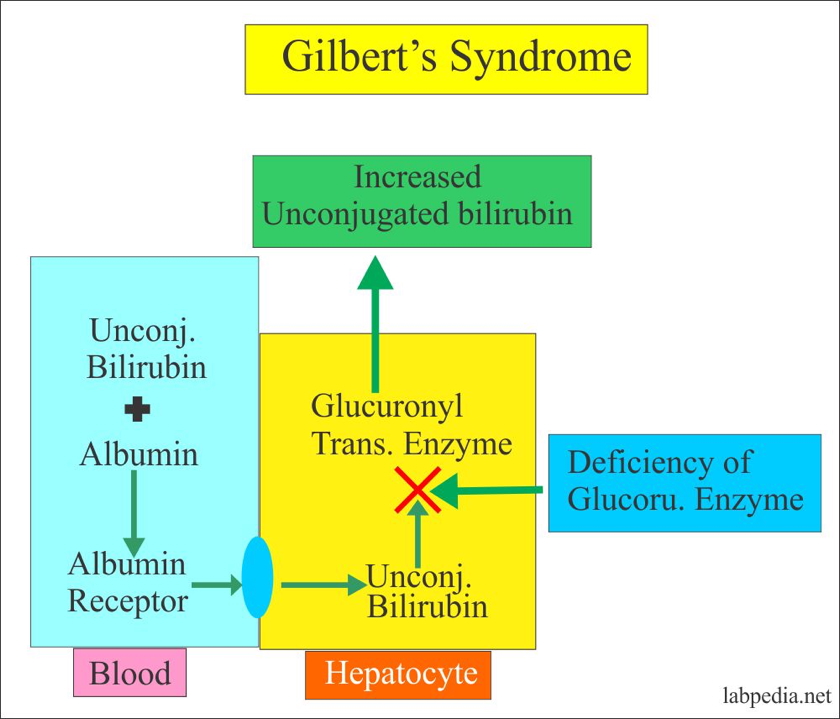
- Deficiency of hepatic UDP-glucuronosyltransferase enzyme
- Conjugation of bilirubin is approximately 30% of normal
- Results in accumulation of unconjugated bilirubin in the bloodstream
- No structural or functional liver damage
Morphology
- No histological or structural liver abnormalities
- Liver appears normal on imaging
Clinical Features
Symptoms
- Most patients are asymptomatic
- May experience mild jaundice during:
- Fasting
- Intercurrent illness (especially infections)
- Physical exertion
- Emotional stress
Signs
- Mild scleral icterus (intermittent)
- No hepatomegaly or splenomegaly

Investigations
- Isolated rise in unconjugated bilirubin
- Normal:
- Liver enzymes (ALT, AST, ALP, GGT)
- Reticulocyte count (excludes haemolysis)
- Full blood count and haemolysis screen
Management
- No treatment required
- Reassurance is key
- Patient education to avoid unnecessary concern or testing during episodes of jaundice
Complications
- None
- Does not progress to liver disease or require intervention
Differential Diagnosis
- Haemolytic anaemia (will have ↑ reticulocytes, ↑ LDH)
- Crigler-Najjar syndrome (more severe unconjugated hyperbilirubinaemia)
- Viral hepatitis (associated with elevated transaminases)
- Drug-induced liver injury
Summary – Gilbert’s Syndrome
Gilbert’s syndrome is a benign hereditary condition causing intermittent unconjugated jaundice due to a partial enzyme deficiency in bilirubin conjugation. It is typically asymptomatic and requires no treatment. Diagnosis is made by exclusion, with isolated raised unconjugated bilirubin and otherwise normal liver function tests. For a broader context, see our Gastrointestinal Overview page.