
Table of Contents
Overview – Spine Examination
The spine examination is a fundamental part of any musculoskeletal or neurological OSCE station, particularly when assessing for back pain, postural abnormalities, or nerve impingement. It evaluates spinal alignment, movement, and neurological function, and is critical in diagnosing conditions such as ankylosing spondylitis, disc herniation, scoliosis, and nerve root compression.
General Setup
- Wash your hands, introduce yourself, confirm patient name and age.
- Explain the examination and gain consent.
- Ask the patient to stand upright in shorts (spine fully visible).
Inspection
- Examine from the front, sides, and back.
- Assess spinal curvature:
- Cervical lordosis
- Thoracic kyphosis
- Lumbar lordosis
- Look for scoliosis (e.g. in ankylosing spondylitis).
- Check for a question mark posture, commonly seen in ankylosing spondylitis:
- Flattened lumbar lordosis
- Exaggerated thoracic kyphosis
- Cervical hyperextension
- Protruding abdomen (pot belly)
Palpation
- Use finger tips to palpate each spinal vertebra from cervical to sacral regions.
- Palpate the sacroiliac joints.
- Palpate paravertebral muscles on both sides simultaneously.
- Assess for tenderness and temperature changes (suggestive of inflammation or infection).
Movement (Active)
Lumbar Spine
- Flexion: Ask patient to touch their toes.
- Extension: Ask patient to lean backwards.
- Lateral flexion: Slide hand down lateral aspect of leg (both sides).
Cervical Spine
- Flexion: Chin to chest.
- Extension: Look up at the ceiling.
- Lateral flexion: Ear to shoulder (both sides).
- Rotation: Look left, then right.
Thoracic Spine
- Ask patient to sit at the edge of bed, arms crossed.
- Stabilize pelvis.
- Ask for left and right rotation.
Special Tests
Straight Leg Raise (Lasegue Test)
- While lying flat, passively raise extended leg.
- Positive if posterior leg pain occurs between 30–70° → suggests lumbar disc herniation (L4–S1).
Femoral Nerve Stretch Test
- Patient in prone position.
- Extend the hip with the knee flexed.
- Positive if anterior thigh pain → suggests upper lumbar impingement (L2–L4).
Schober’s Test (Lumbar Flexion)
- Mark a line at L5 (level of PSIS dimples).
- Mark 5 cm below and 10 cm above.
- Ask patient to touch toes with knees straight.
- Distance between marks should increase by ≥5 cm; if not, suggests ankylosing spondylitis.
Occiput-to-Wall Test
- Ask patient to stand with back against wall.
- Positive if occiput does not touch wall → indicative of thoracic kyphosis.
To Complete the Examination
- Examine the joints above and below (hip, shoulders).
- Perform a neurological examination of the limbs.
- Consider respiratory assessment (chest expansion, auscultation).
- Order imaging if indicated (e.g. spinal X-ray, MRI).
Related Conditions and Complications
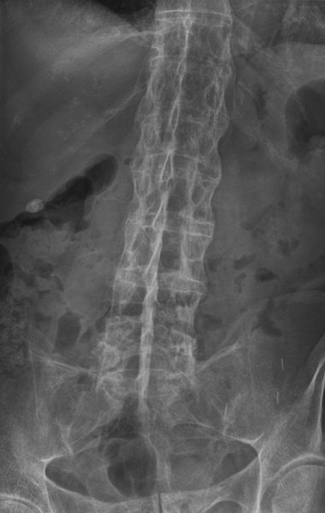
Ankylosing Spondylitis (AS)
- A chronic inflammatory disease affecting the axial skeleton.
- Clinical complications:
- Anterior uveitis
- Apical pulmonary fibrosis → reduced chest expansion
- Aortic insufficiency, atrioventricular block
- Cauda equina syndrome
- Osteoporosis
Summary – Spine Examination
The spine examination assesses spinal curvature, mobility, and neurological integrity, helping to diagnose key conditions like ankylosing spondylitis, scoliosis, and disc herniation. It includes inspection, palpation, movement tests, and special maneuvers like Schober’s and straight leg raise. For a broader context, see our Clinical Skills Overview page.