
Table of Contents
Overview – Ichthyosis Vulgaris
Ichthyosis vulgaris is the most common form of inherited skin scaling disorder, characterised by dry, scaly skin due to abnormal keratinisation. It typically appears in early childhood and may improve with age or persist into adulthood. Management is focused on barrier repair and hydration.
Aetiology
- Genetic (autosomal semidominant inheritance)
- Caused by loss-of-function mutations in the FLG gene (filaggrin)
- Can also be acquired (less common)
- Often associated with systemic conditions (e.g. malignancy, hypothyroidism)
Epidemiology
- Most common inherited ichthyosis
- Predominantly affects people of European descent
- Usually presents within the first few months of life
Pathophysiology
- Filaggrin is essential for epidermal barrier function
- Mutation in filaggrin gene → impaired aggregation of keratin fibres
- Leads to:
- Defective skin barrier
- Increased transepidermal water loss → xerosis (dry skin)
- Hyperkeratosis and accumulation of scales
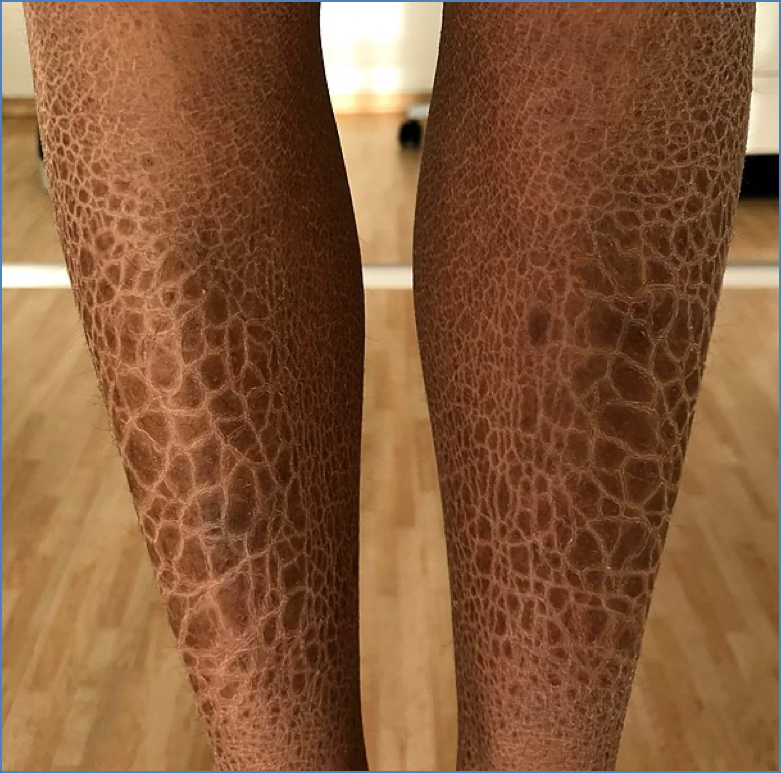
Clinical Features
- Appears around 2 months of age
- Dry, scaly skin – especially:
- Extensor surfaces of limbs
- Scalp
- Face
- Trunk
- Flexural areas typically spared
- Symptoms may worsen in winter/cold climates
- May improve with age or become less noticeable after puberty
Diagnosis
- Clinical diagnosis based on typical appearance
- Family history and early childhood onset support diagnosis
- Skin biopsy rarely needed but shows compact hyperkeratosis and reduced/absent granular layer
Management
- Daily moisturisation:
- Use emollients with high lipid content (e.g. lanolin-based creams)
- Bathing practices:
- Bathe in salt water to soften scale
- Use of keratolytic agents:
- Salicylic acid, urea, or lactic acid creams
- Severe cases:
- May require oral retinoids (e.g. isotretinoin)
- Regular dermatological follow-up
Summary – Ichthyosis Vulgaris
Ichthyosis vulgaris is the most common inherited skin disorder, caused by mutations in the filaggrin gene leading to defective skin barrier function and xerosis. It typically presents in early childhood with dry, scaly skin, especially on extensor surfaces, and often worsens in dry or cold climates. While not curable, it is manageable with regular emollients and keratolytics.
For a broader context, see our Skin & Dermatology Overview page.