
Table of Contents
Overview – Cryptorchidism
Cryptorchidism, or undescended testes, is a common congenital condition in which one or both testicles fail to descend into the scrotal sac. It affects up to 4% of full-term male infants and is strongly associated with increased risk of infertility and testicular cancer later in life. Early recognition and surgical intervention are essential to preserve fertility and minimise malignant transformation.
Definition
Cryptorchidism is the failure of one or both testicles to descend from the abdomen through the inguinal canal into the scrotum during fetal development or early infancy.
Aetiology
- Idiopathic in most cases
- Associated with:
- Prematurity
- Low birth weight
- Genetic syndromes (e.g. Klinefelter, Prader-Willi)
- Hormonal imbalances affecting androgen or gonadotropin secretion
Pathogenesis
- During fetal development, the testes typically descend into the scrotum via the inguinal canal under hormonal and mechanical influences.
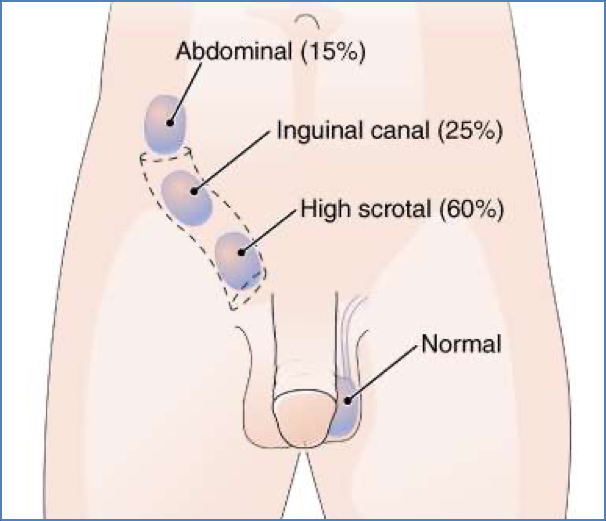
- Cryptorchidism occurs when this descent is incomplete or arrested, commonly:
- High scrotal (60%)
- Inguinal canal (25%)
- Abdominal cavity (15%)
Clinical Features
- Undescended testis on clinical examination (empty scrotum)
- Usually unilateral, but can be bilateral
- Most are palpable within the inguinal canal
- Typically asymptomatic in infancy
- Often diagnosed during routine newborn exam or early childhood
- Spontaneous descent is common in the first year of life
- If not descended by 12 months, spontaneous resolution unlikely
Complications
- ↑ Risk of testicular cancer (3–5x higher risk), especially with intra-abdominal testes
- Infertility due to impaired spermatogenesis
- Testicular torsion or trauma (especially if located in inguinal canal)
- Psychosocial impact due to cosmetic differences
Investigations
- Clinical examination – primary diagnostic method
- Ultrasound – to confirm presence and location of testis
- MRI or laparoscopy – if testis is non-palpable and not visible on ultrasound
- Hormonal tests (e.g. inhibin B, AMH) – may assist in confirming presence of functional testicular tissue
Management
- Observation:
- If <6 months old, as spontaneous descent is common
- Surgical correction (Orchidopexy):
- Ideally performed between 6–18 months of age
- Testis is mobilised and fixed within the scrotum
- Hormonal therapy (e.g. hCG, GnRH analogues):
- Rarely used due to lower success rates compared to surgery
Summary – Cryptorchidism
Cryptorchidism is the failure of testicular descent into the scrotum, typically presenting as an empty scrotum in infancy. While often asymptomatic, it significantly increases the risk of testicular cancer and infertility if untreated. Early diagnosis and timely surgical orchidopexy are essential. For a broader context, see our Reproductive Health Overview page.