
Table of Contents
Overview – Families
Families are the foundational social unit of society, influencing child development, health outcomes, socialisation, and emotional wellbeing. In clinical medicine and psychiatry, understanding family structure, function, and dynamics is essential to appreciating both support systems and stressors affecting patients. This article outlines different family types, roles, psychosocial stressors, and the impact of dysfunction on health.
Definition
A family is defined as two or more persons, at least one of whom is aged 15 years or older, related by blood, marriage, adoption, step-relation, or fostering, and residing in the same household.
Family Structures
Types of Families
- Nuclear family
- Single-parent household
- Step/blended family
- Homosexual couple/family
- Communal living families
Distribution in Developed Countries
- ~90% of households are ‘family’ households
- ~47% of family households include children
- ~90% of those with children are raising their own biological children
Roles Within the Family
- Identified Parent(s) – formal caregiving role
- Parentified Child – child takes on adult responsibilities (e.g. sibling care)
- Black Sheep – scapegoated or non-conforming child
- Good Child – high-achieving, approval-seeking
- Distracter – provides humour or disruption to divert from conflict
- Caretaker – often takes on emotional or practical caregiving roles (e.g. “Cinderella”)
Family Hierarchies & Structures
- Normal hierarchy – clear roles, generational boundaries
- Parentified child – child assumes adult duties
- No hierarchy – poor boundaries, lack of guidance or discipline
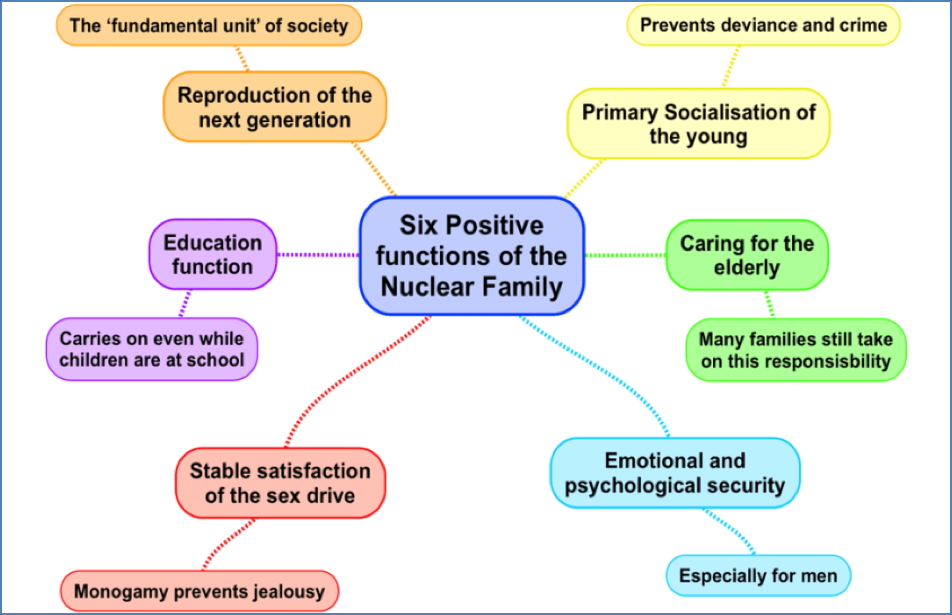
Core Functions of Families
Reproduction and Child Rearing
- Birth, protection, feeding
- Education and moral/social development
Love and Attachment
- Provides primary attachment (especially parent-child)
- In adulthood, attachment may become sexual or romantic
Sexual Regulation
- Families define appropriate sexual partners (e.g. by age, relation)
Economic Support
- Division of labour across:
- Income generation
- Childcare and elder care
- Housework
- Protection and housing maintenance
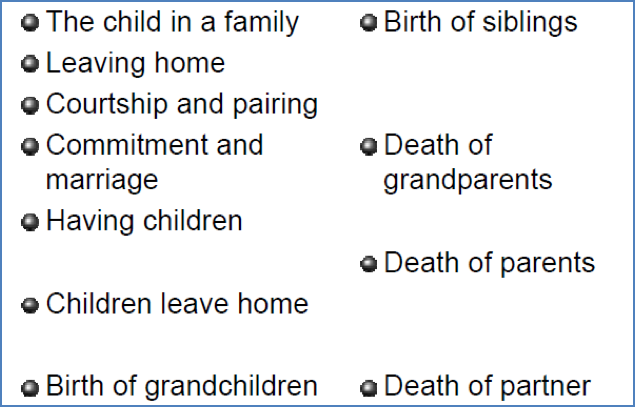
Family Life Cycle
Includes predictable stages: couple formation → child-rearing → child independence → ageing and loss
Stages often intersect with stress points such as financial strain, illness, or grief
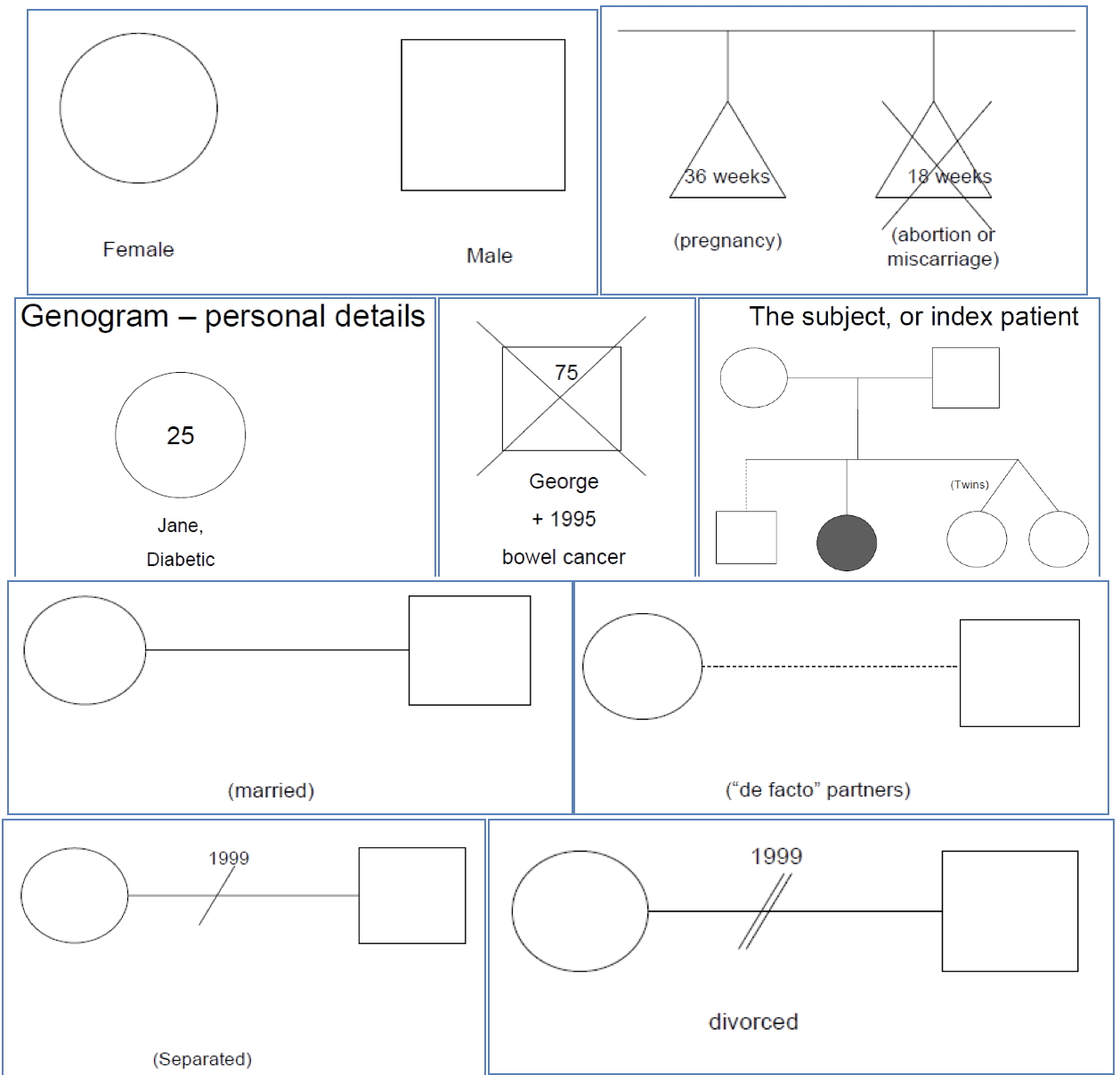
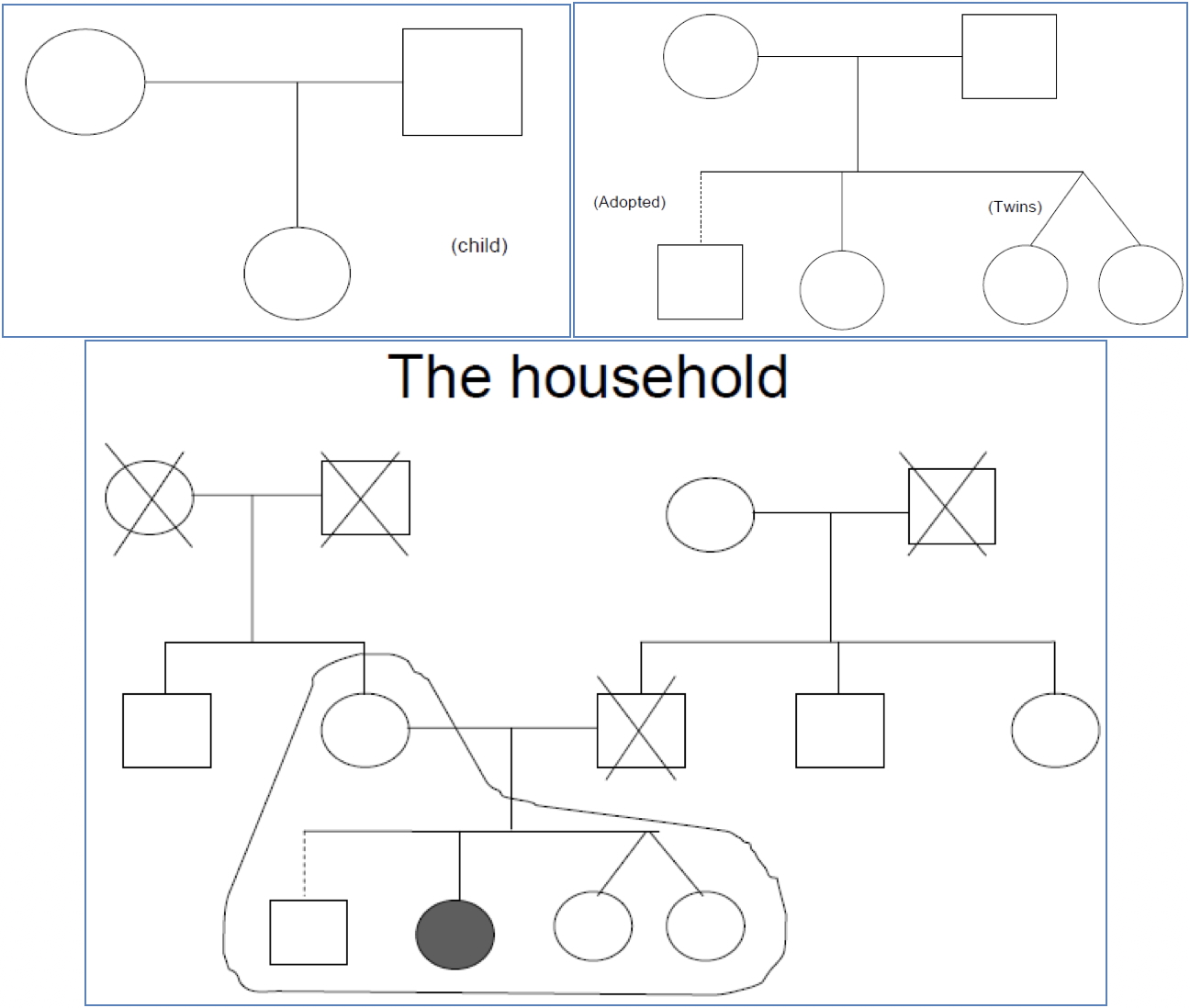
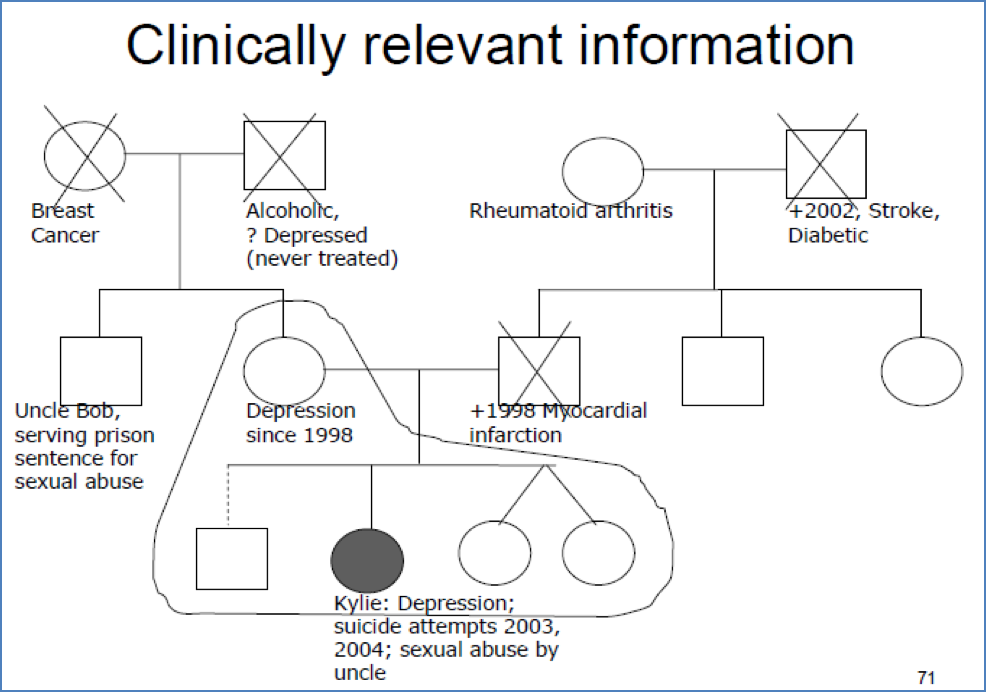
Genograms
- Visual representation of family structure and history
- Similar to pedigree but focuses on social and medical dynamics
- Symbols include:
- Circle = female
- Square = male
- Triangle = pregnant
- Shaded = patient/subject
- Crossed shape = deceased
- Lines depict relationships (solid, dotted, crossed for married, de facto, divorced etc.)
The Family Under Stress
Migration
- Disrupts extended kinship networks
Economic Pressures
- Dual-working-parent households
- Role strain and reduced time for caregiving
Cultural Change
- Decline of traditional structures (e.g. religion, indigenous customs)
Divorce
- Risk factors: unemployment, marrying <20
- No definitive evidence that divorce harms children
- Divorce can increase risk of depression, anxiety, and suicide
Domestic Violence
- Includes abuse of partners, children, or elders
- Affects up to 25% of women
- Victim effects: physical harm, PTSD, pregnancy complications, substance abuse
- Child effects: aggression, poor school performance, self-harm, sleep issues
Child Abuse
- Childhood effects: attachment issues, self-harm, poor education
- Adult effects: personality disorders, depression, addiction, criminality
Health and the Family
- Chronic illness (e.g. cancer, mental illness, genetic disorders) impacts all family members
- A sick child can strain intra-family relationships, financial stability, and parental wellbeing
Functional vs Dysfunctional Families
Functional Families
- Encourage participation
- Promote love, value, and flexibility
- Handle conflict openly and respectfully
- Foster a climate of trust
Dysfunctional Families
- Pseudomutuality: superficial harmony hides real issues
- Pseudohostility: constant low-level conflict masks intimacy
- Marital schisms: chronic parental conflict, triangulation with children
- Marital skew: one parent dominates excessively while the marriage remains intact
- Enmeshment: overly diffuse boundaries → over-involvement
- Disengagement: rigid boundaries → lack of involvement or support
Challenges in Different Family Types
Single-Parent Families
- Financial strain
- Attachment needs unmet for the parent
- Overburdened roles may lead to unmet child needs
Blended/Reconstituted Families
- Often economically more stable
- Sources of stress include:
- Role expectations
- Sexual boundaries
- Love and attachment rivalries
Stepfamilies
- Higher rates of physical/sexual abuse
- Disciplinary role confusion
- Power struggles between parent-figures and children
Summary – Families
Families are the primary environment for socialisation, emotional regulation, and caregiving. Their structure, function, and capacity to adapt under stress significantly influence individual mental health. Understanding family dynamics, genograms, and functional vs dysfunctional patterns is vital for medical and psychiatric assessment. For a broader context, see our Psychiatry & Mental Health Overview page.