
Table of Contents
Overview – Somatosensory Pathways
Somatosensory pathways transmit information about touch, temperature, pain, and proprioception from the body to the brain. These ascending tracts are essential for perception, coordination, and protective reflexes. This article outlines the three major somatosensory pathways—Dorsal Column, Spinothalamic, and Spinocerebellar—along with key neurotransmitters and receptors involved in sensory processing.
Neuronal Organisation
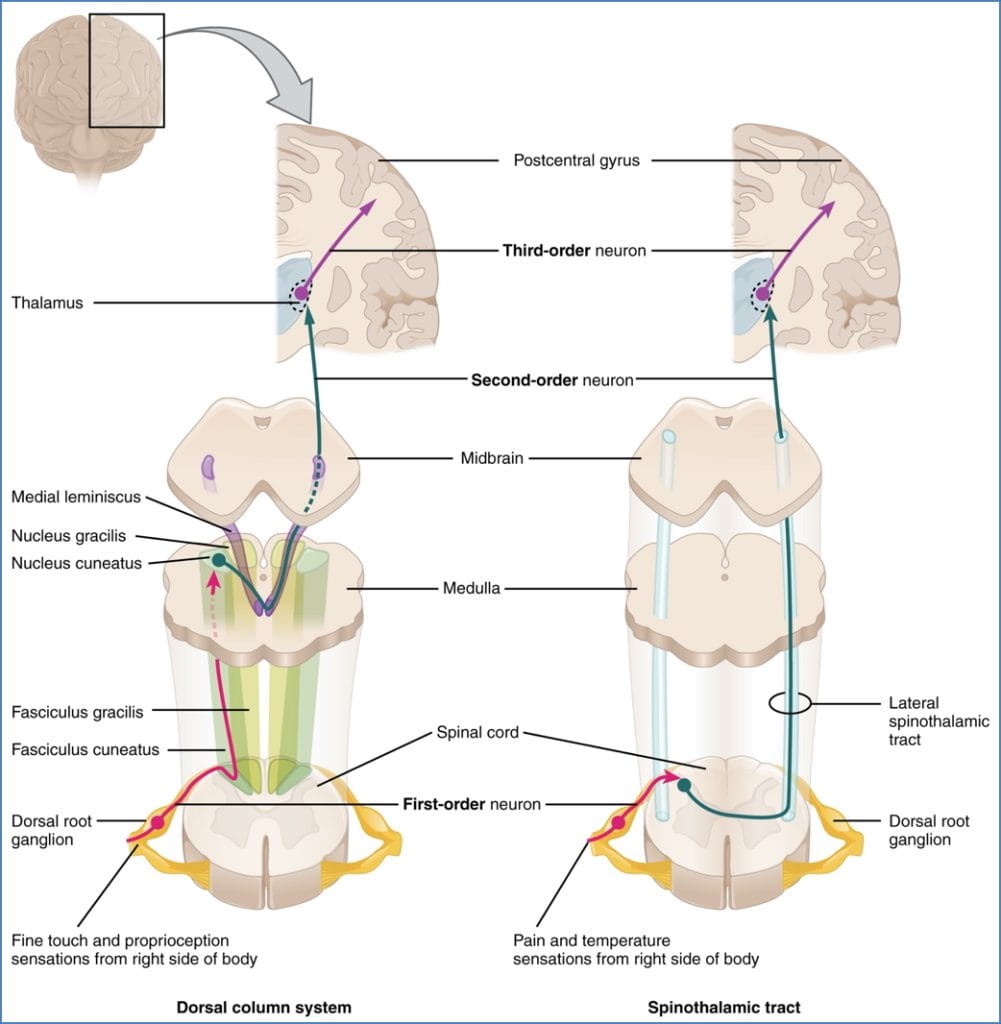
First-Order Neurons
- Peripheral afferents (e.g. dorsal roots, cranial nerves)
- Cell bodies in dorsal root ganglia (pseudounipolar neurons)
- Enter spinal cord via dorsal horn
- Sensory input is frequency coded
Second-Order Neurons
- Located in spinal cord or brainstem
- Synapse with 1st-order neurons
- Decussation (crossing midline) often occurs here
- Relay sensory information to thalamus or cerebellum
Third-Order Neurons
- Located in the thalamus
- Project to primary somatosensory cortex (parietal lobe)
Note: Only relevant to Dorsal Column and Spinothalamic pathways
Spinocerebellar pathway ends at cerebellum with second-order neurons
Major Ascending Tracts
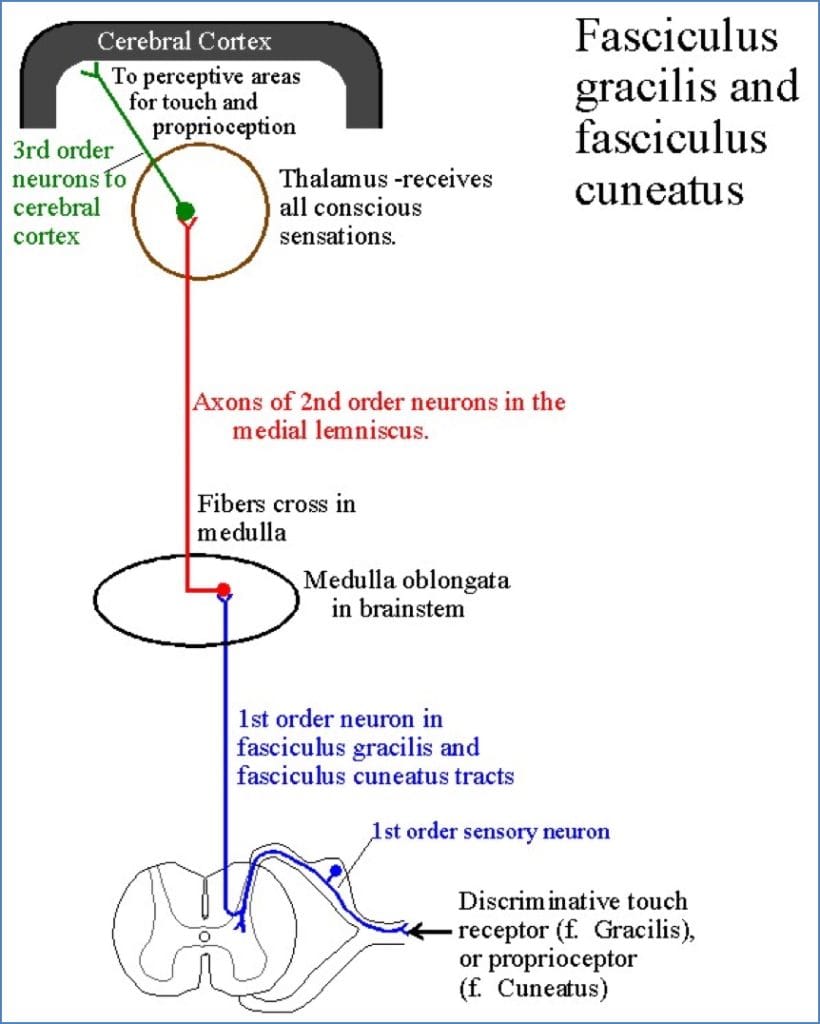
Dorsal Column Pathway
- Synapse site: Medulla
- Decussation: Medulla
- Fibre characteristics: Large, myelinated, rapidly adapting
- Function:
- Fine touch
- Vibration
- 2-point discrimination
- Conscious proprioception
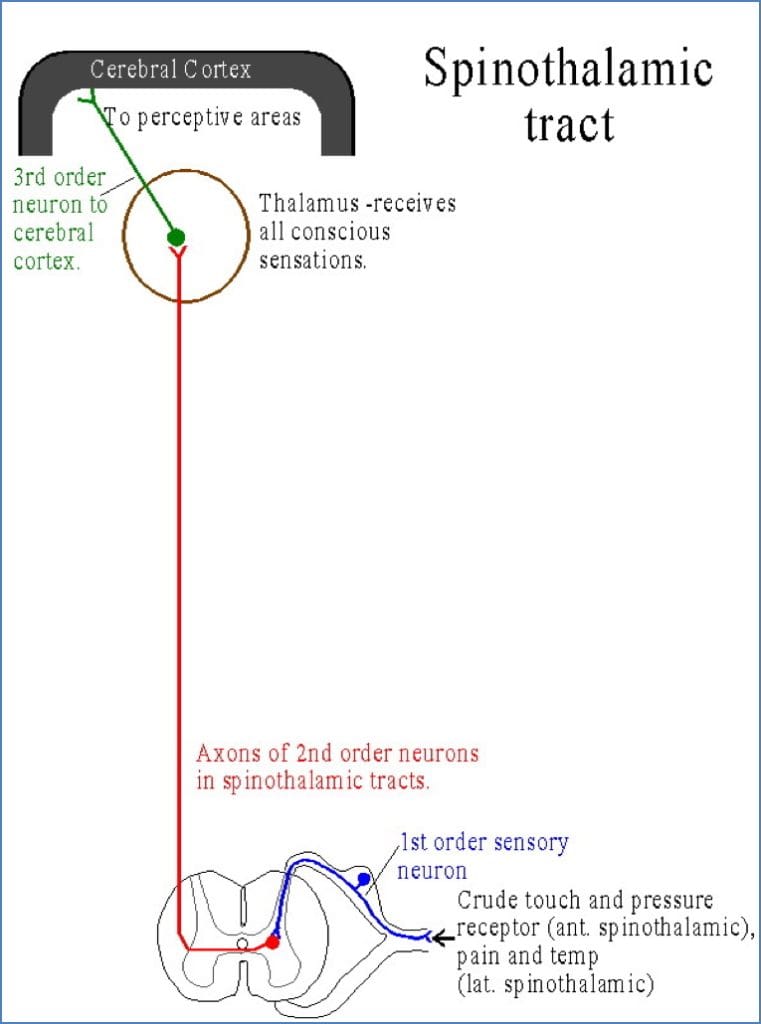
Spinothalamic Pathway
- Synapse site: Spinal cord (at entry level)
- Decussation: Spinal cord (at entry level)
- Fibre characteristics: Small, myelinated, slowly adapting
- Function:
- Crude touch
- Pressure
- Pain
- Temperature
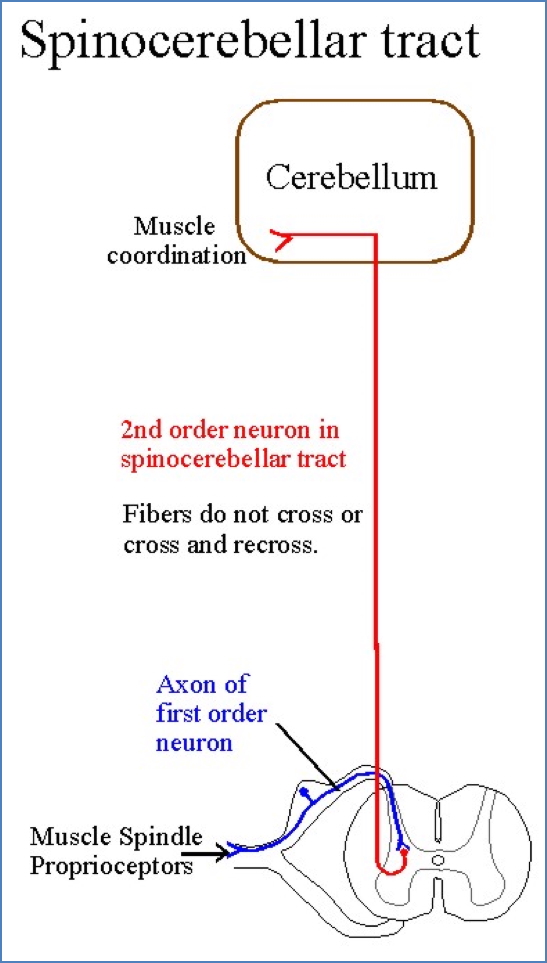
Spinocerebellar Pathway
- Synapse site: Spinal cord
- Decussation: None (remains ipsilateral)
- Fibre characteristics: Large, myelinated, slowly adapting
- Function:
- Unconscious proprioception
- Muscle spindle, Golgi tendon, and joint capsule input
- Coordinates skeletal muscle activity
Sensory Receptors & Ion Channels
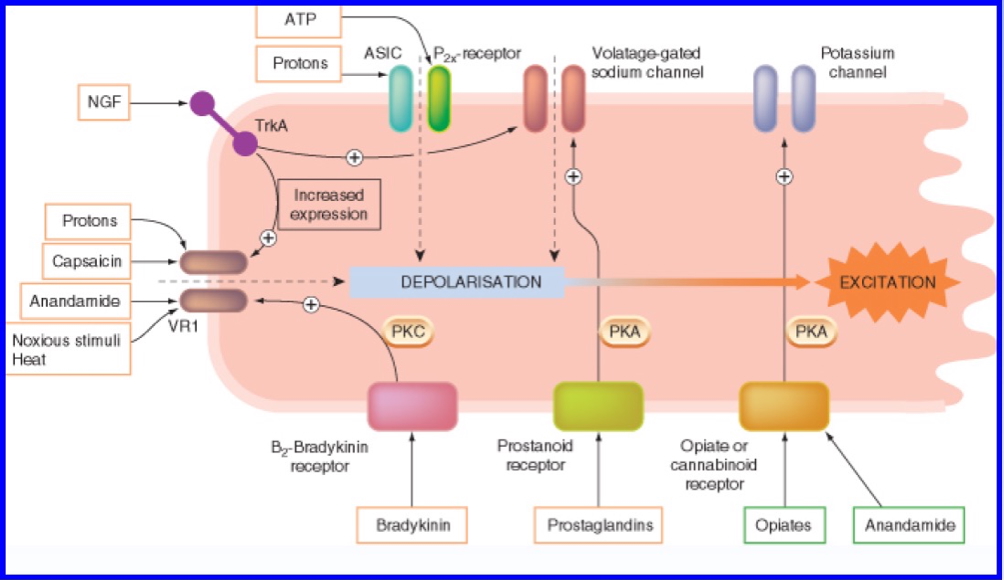
Key Receptors at Sensory Nerves
- TRPV1 (Ca²⁺ channel)
- Activated by: capsaicin, heat, acid (H⁺), mechanical stimuli
- Bradykinin Receptor
- Triggers TRPV1 → depolarisation → nociception
- Prostanoid Receptors
- Activated by prostaglandins
- Effects: open Na⁺ channels, inhibit K⁺ channels → lowers threshold
- ASIC (Acid-Sensitive Ion Channel)
- H⁺ → depolarisation → pain
- Opioid/Cannabinoid Receptors
- Open K⁺ channels → hyperpolarisation → decreased sensitivity
Neurotransmitters in the Dorsal Horn
Afferent Neurotransmitters
- Substance P
- Glutamate
- AMPA and NMDA receptors involved in pain transmission
Efferent Inhibitory Modulators
- Opioids
- Activate descending inhibition
- Noradrenaline
- Inhibits synaptic transmission
- Serotonin (5-HT)
- Inhibits synaptic transmission
- Enkephalins
- Endogenous opioid peptides → inhibit nociceptive transmission
Clinical Note: Low-dose tricyclic antidepressants relieve neuropathic pain by inhibiting reuptake of NE, 5-HT, and enkephalins in the dorsal horn
Summary – Somatosensory Pathways
The somatosensory system relies on three major ascending pathways to convey touch, pain, temperature, and proprioception to the brain. Each pathway features a unique neuronal relay pattern and decussation site. Neurotransmitters and ion channels modulate sensitivity and signal strength at every level. For a broader context, see our Nervous System Overview page.