
Table of Contents
Overview – Lumbar & Sacral Plexuses
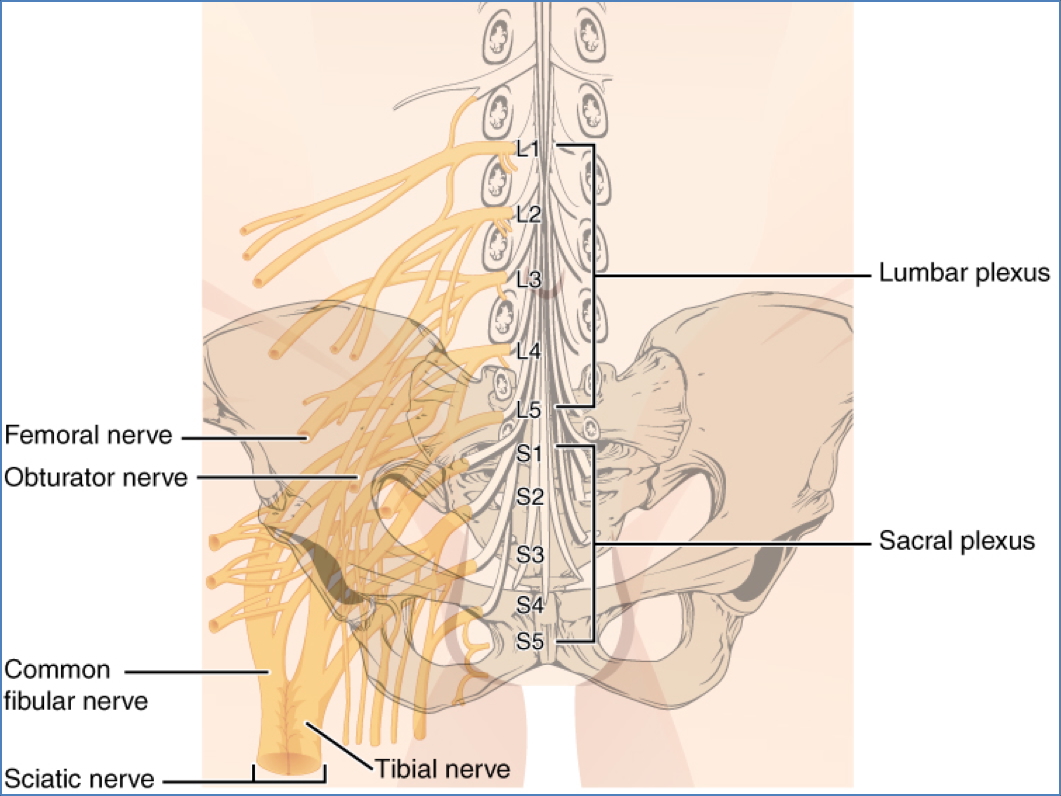
The lumbar and sacral plexuses are major nerve networks arising from the spinal cord that supply motor and sensory innervation to the pelvis and lower limbs. Together, they form the lumbosacral plexus, critical for lower limb function, gait, and pelvic control. Understanding their branches is essential for localising neurological lesions and planning regional anaesthesia.
Lumbar Plexus
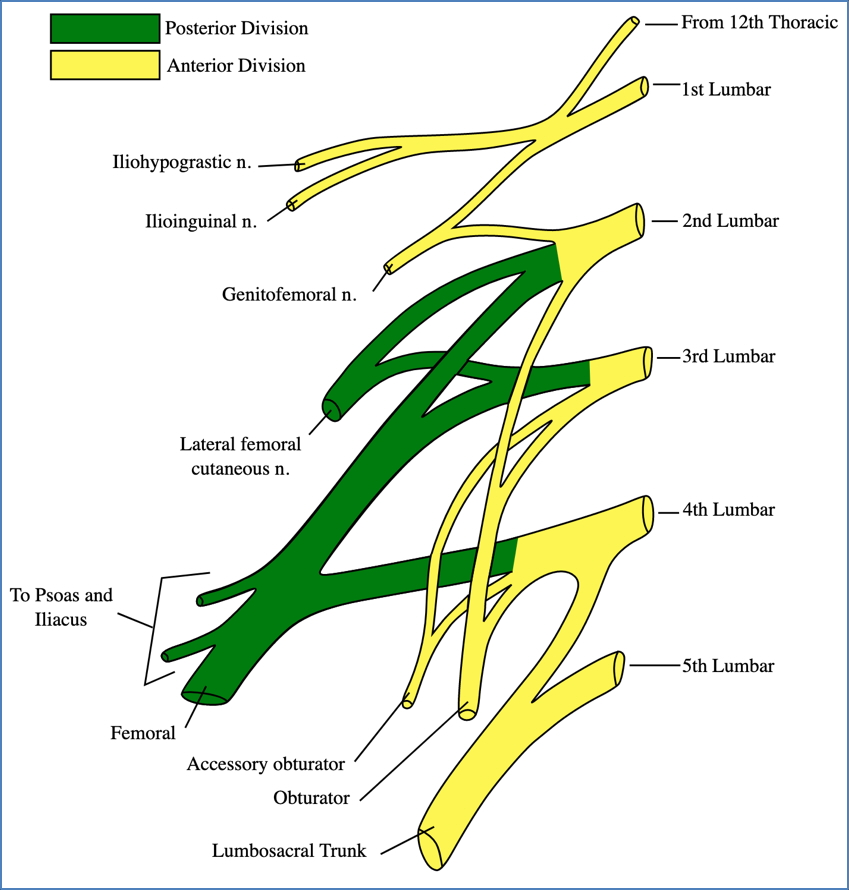
- Roots: Ventral rami of L1–L4
- Location: Embedded in the psoas major muscle, anterior to the lumbar vertebrae
- Function: Supplies anterior and medial thigh, skin of lower abdomen, and parts of the lower leg
Femoral Nerve
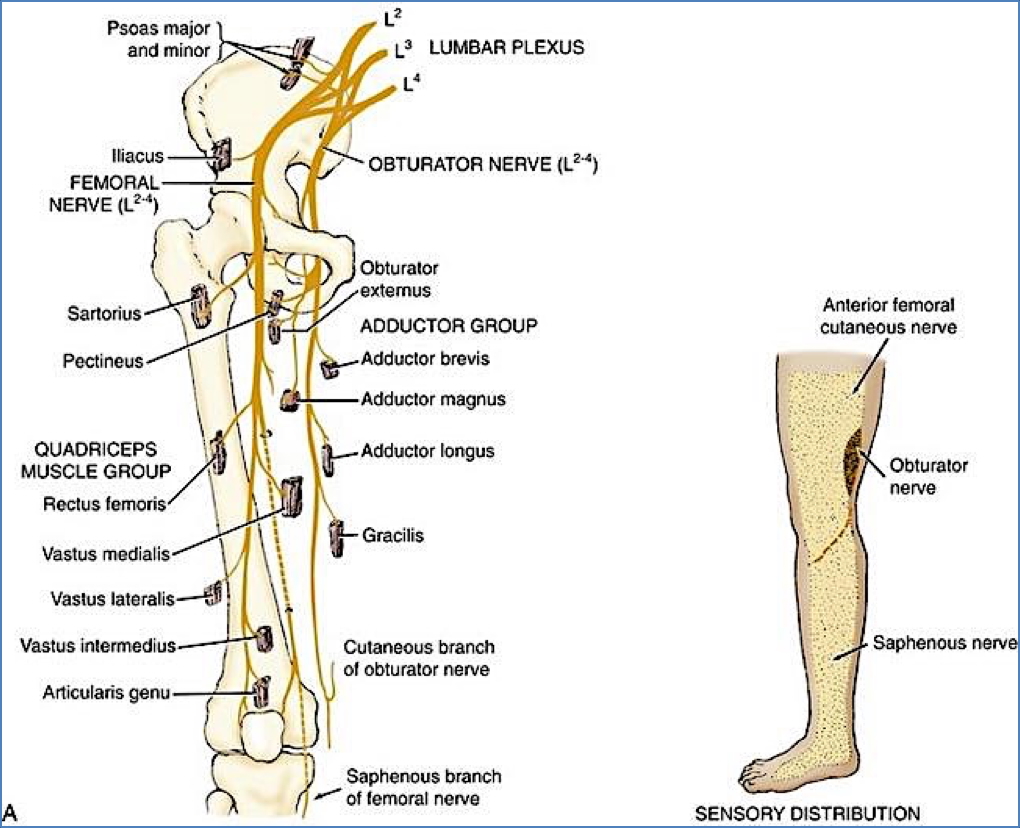
- Roots: L2–L4
- Course: Between psoas major and iliacus → beneath inguinal ligament → anterior thigh
- Divisions:
- Anterior: Sartorius, Pectineus + Cutaneous branches
- Posterior: Quadriceps femoris + Saphenous nerve (cutaneous)
- Motor Innervation:
- Pectineus
- Sartorius
- Quadriceps femoris:
- Rectus femoris
- Vastus lateralis
- Vastus intermedius
- Vastus medialis
- Sensory Innervation:
- Anteromedial thigh and lower leg
- Medial aspect of the foot (via saphenous nerve)

Obturator Nerve
- Roots: L2–L4
- Course: Medial to psoas major → through obturator canal → medial thigh
- Motor Innervation:
- External obturator
- Adductor longus
- Adductor brevis
- Adductor magnus (adductor portion)
- Gracilis
- Sensory Innervation:
- Skin of medial thigh
Sacral Plexus
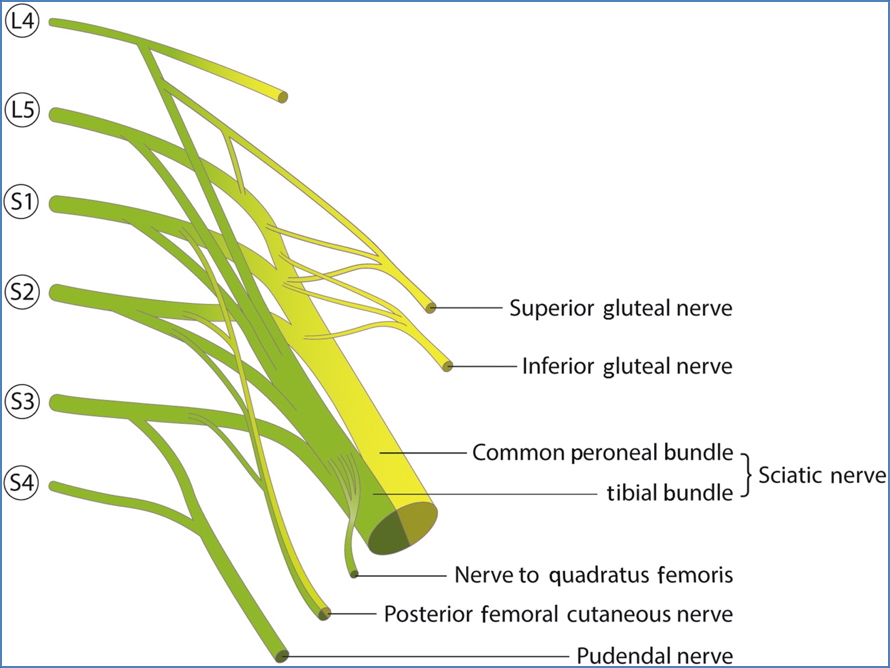
- Roots: L4–S4
- Location: Posterior pelvis, in front of the piriformis muscle
- Function: Supplies posterior thigh, leg, foot, and most of the pelvis
Superior Gluteal Nerve
- Roots: L4–S1
- Course: Exits pelvis via greater sciatic foramen above piriformis
- Motor Innervation:
- Gluteus medius
- Gluteus minimus
- Tensor fasciae latae
Inferior Gluteal Nerve
- Roots: L5–S2
- Course: Greater sciatic foramen below piriformis
- Motor Innervation:
- Gluteus maximus
Sciatic Nerve
- Roots: L4–S3
- Course: Exits via greater sciatic foramen (below piriformis) → descends posterior thigh → bifurcates into tibial and common fibular nerves
- Motor Innervation:
- Hamstring muscles
- Adductor magnus (hamstring portion)
Terminal Branches of the Sciatic Nerve
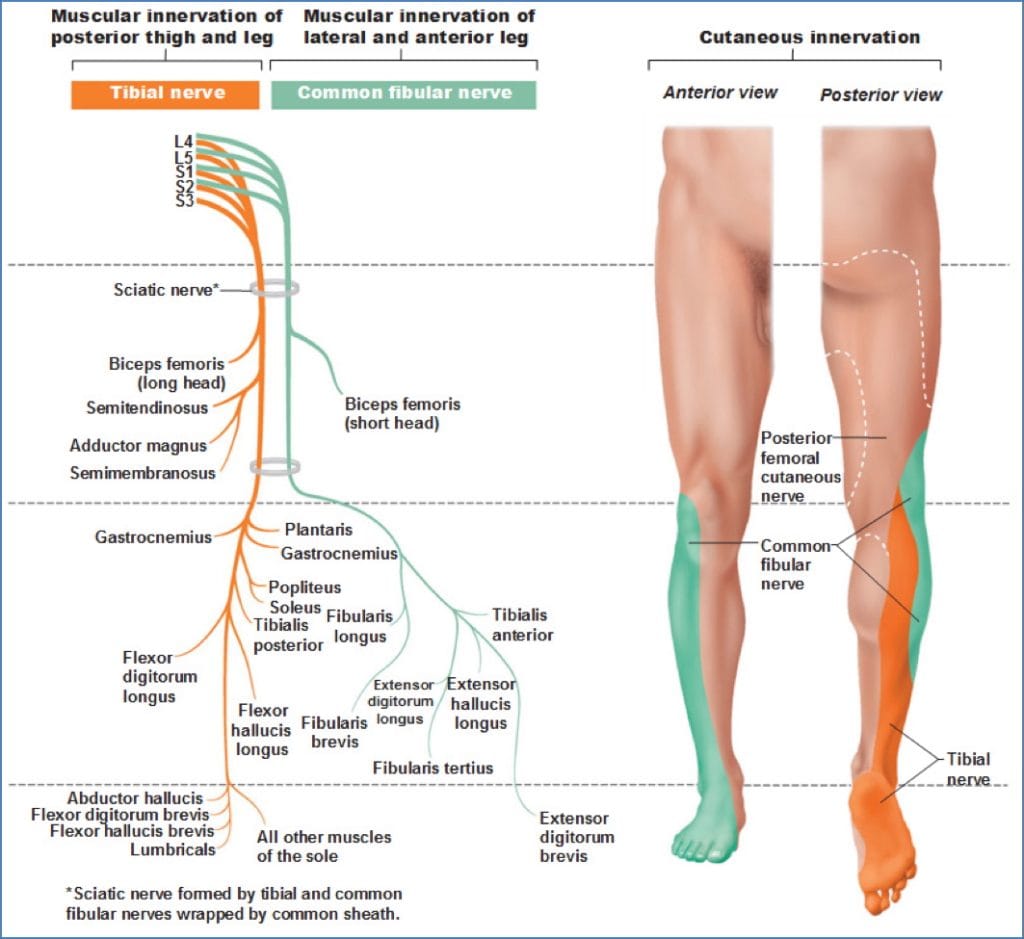
Common Fibular (Peroneal) Nerve
- Course: Travels laterally in the popliteal fossa → wraps around fibular neck → divides into:
- Deep Fibular Nerve
- Motor:
- Tibialis anterior
- Extensor digitorum longus
- Extensor hallucis longus
- Fibularis tertius
- Sensory:
- 1st web space of the foot
- Motor:
- Superficial Fibular Nerve
- Motor:
- Fibularis longus
- Fibularis brevis
- Sensory:
- Dorsum of the foot
- Motor:
- Deep Fibular Nerve
Tibial Nerve
- Course: Through popliteal fossa → posterior leg → medial malleolus → divides into medial & lateral plantar nerves
- Motor Innervation:
- Gastrocnemius
- Soleus
- Plantaris
- Popliteus
- Tibialis posterior
- Flexor digitorum longus
- Flexor hallucis longus
- Sensory Innervation:
- Posterior leg
- Plantar surface of the foot
Summary – Lumbar & Sacral Plexuses
The lumbar and sacral plexuses form the key neural supply to the pelvis and lower limbs. The femoral and obturator nerves dominate anterior and medial thigh innervation, while the sciatic nerve and its branches control posterior limb and foot function. These plexuses are crucial to understand for assessing lower limb neurology and surgical approaches.
For more foundational content, visit our Nervous System Overview page.