
Table of Contents
Overview – Soil-Transmitted Helminths
Soil-transmitted helminths are intestinal parasites that affect more than a billion people globally, especially in tropical and subtropical regions. These organisms use soil for part of their life cycle and are transmitted via contact with contaminated soil or ingestion of eggs or larvae. Understanding their lifecycle and pathogenic effects is crucial for public health and tropical medicine. The most common species include Ascaris lumbricoides, Trichuris trichiura (whipworm), hookworm, and Strongyloides stercoralis.
Definition
Soil-transmitted helminths (STHs) are a group of parasitic worms that infect the human gastrointestinal tract and rely on soil-based stages to mature from eggs or larvae into their infective forms.
Aetiology
Common STHs:
- Roundworm (Ascaris lumbricoides)
- Whipworm (Trichuris trichiura)
- Hookworm (Ancylostoma duodenale, Necator americanus)
- Strongyloides (Strongyloides stercoralis)
These helminths are transmitted through contaminated soil—usually in areas with poor sanitation and warm, humid conditions that support the maturation of eggs or larvae.
Life Cycle & Pathogenesis
All soil-transmitted helminths:
- Live in the gastrointestinal tract
- Release eggs (or larvae) into faeces
- Require a soil-based stage to mature into the infective form
- Infect new hosts via ingestion or skin penetration
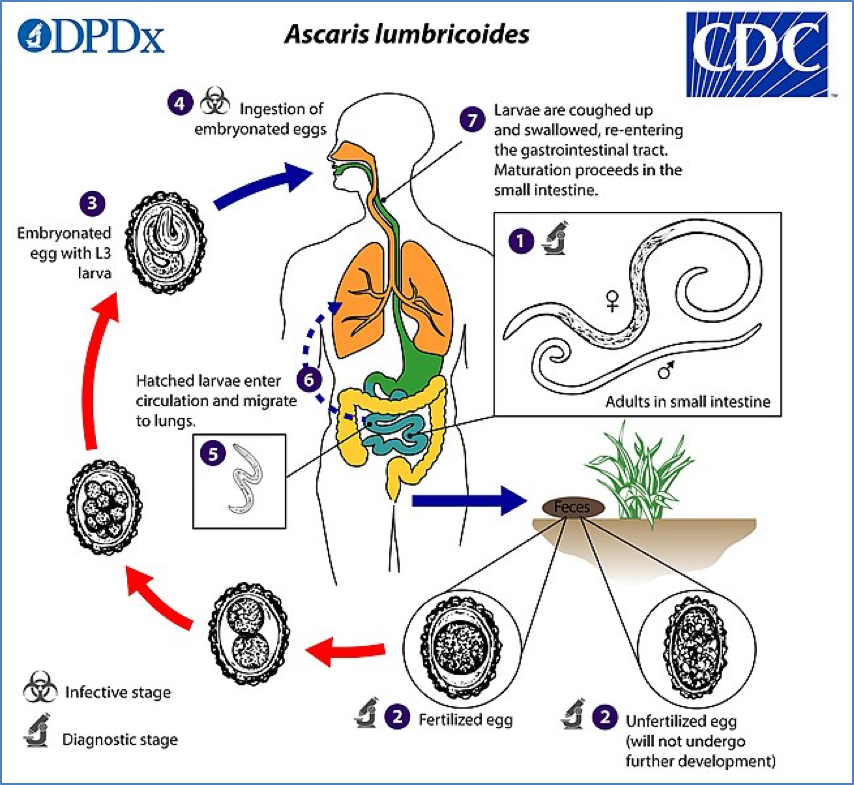
Ascaris lumbricoides (Roundworm)
- Infective eggs ingested → hatch in small intestine
- Larvae migrate via bloodstream to lungs → coughed up and swallowed
- Mature in small intestine
- No attachment organ; feeds on intestinal contents
- Strong swimmer
Trichuris trichiura (Whipworm)
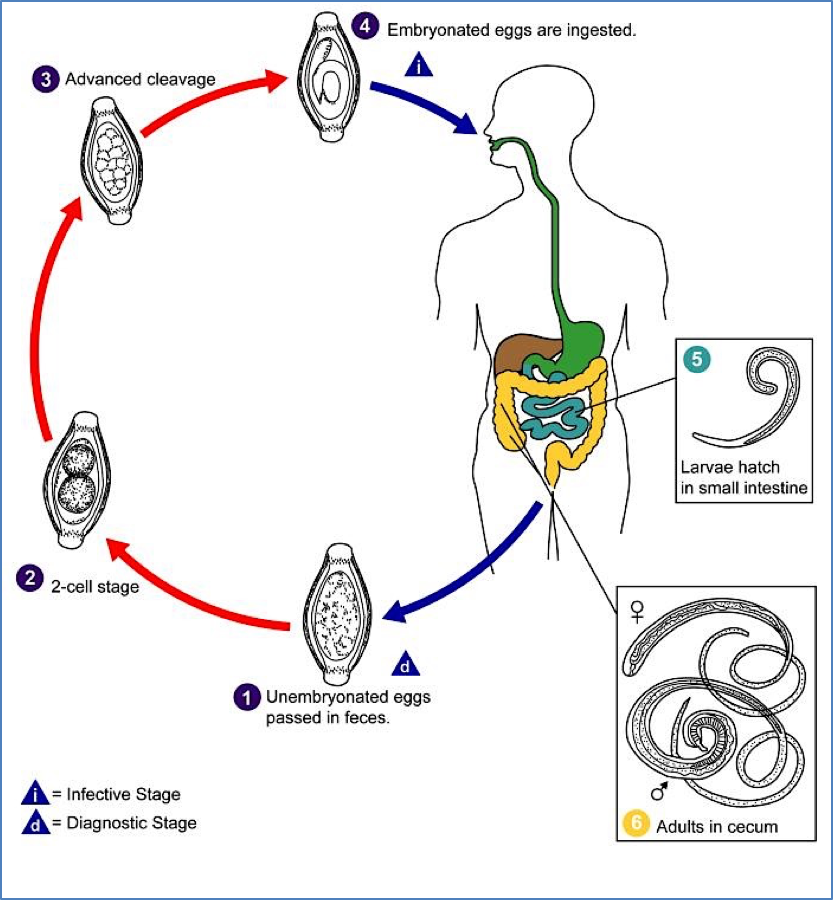
- Ingested eggs hatch in the large intestine
- Adults anchor using their whip-like tail
- Local inflammation and gastrointestinal symptoms
- Heaviest infections cause rectal prolapse in children
Hookworm (Ancylostoma/Necator)
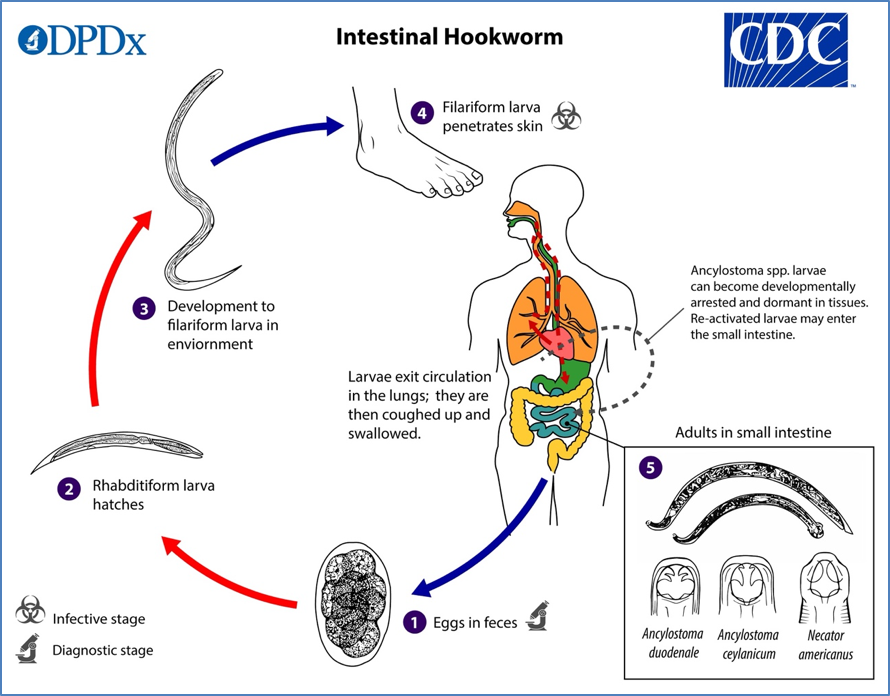
- Eggs hatch in soil → release larvae
- Larvae chase heat → penetrate skin (commonly feet)
- Enter bloodstream → migrate to lungs → trachea → swallowed
- Mature in small intestine
- Attach via mouth to intestinal wall and feed on blood
- Cause iron-deficiency anaemia and protein loss
Strongyloides stercoralis
- Soil-based larvae penetrate skin
- Similar lung-trachea-swallow lifecycle
- Lives in small intestine
- May cause chronic infection due to autoinfection
- Dangerous in immunosuppressed (→ disseminated strongyloidiasis)

Clinical Features
- Asymptomatic in mild infections
- Gastrointestinal symptoms: abdominal pain, bloating, diarrhoea
- Respiratory symptoms during lung migration (e.g. Loeffler’s syndrome in Ascaris)
- Anaemia and protein loss in hookworm infection
- Chronic or disseminated strongyloidiasis in immunocompromised
- Rectal prolapse (whipworm, heavy burden in children)
Investigations
- Stool microscopy: Identification of characteristic eggs or larvae
- Serology/PCR: For Strongyloides, especially in low-burden or chronic cases
- Eosinophilia: Suggestive of helminthic infection
- Full Blood Count: Anaemia (especially in hookworm)
Management
- Albendazole or Mebendazole: Broad coverage for most STHs
- Ivermectin: First-line for Strongyloides stercoralis
- Treat household members and improve sanitation
- Community-based deworming campaigns in endemic areas
Prevention
- Sanitation: Proper disposal of faeces
- Hygiene: Handwashing, avoiding barefoot walking
- Health education and mass drug administration in endemic areas
Summary – Soil-Transmitted Helminths
Soil-transmitted helminths are gastrointestinal parasites that mature in soil and infect humans via ingestion or skin penetration. They include Ascaris lumbricoides, Trichuris trichiura, hookworms, and Strongyloides stercoralis. These parasites thrive in warm, humid climates and are a major public health issue in low-income regions. For more information on infectious agents, see our Microbiology & Public Health Overview page.