
Table of Contents
Overview – Scabies
Scabies is a highly contagious parasitic skin infestation caused by the mite Sarcoptes scabiei. It is a significant cause of dermatological morbidity worldwide, particularly in tropical and resource-limited communities. The condition is characterised by intense nocturnal itching and a widespread, excoriated rash. Scabies does not resolve without treatment, making early recognition and simultaneous treatment of contacts essential for effective control, especially in community settings.
Definition
Scabies is a cutaneous infestation caused by the human-specific mite Sarcoptes scabiei, which burrows into the stratum corneum of the skin and causes a pruritic rash through mechanical disruption and immune response to mite products.
Aetiology
- Causative agent: Sarcoptes scabiei (scabies mite)
- Zoonotic infestations from pigs, horses, and dogs → mild and self-limiting
- Human-to-human infestations → persist without treatment
Pathophysiology
- Mites inhabit the stratum corneum (outermost layer of epidermis)
- Feed on keratinocytes and form burrows via digestion
- Mating occurs on the skin surface; fertilised females burrow into skin to lay eggs
- Salivary proteolytic enzymes digest keratin for nutrition
- No systemic invasion – remains superficial
Transmission
- Direct prolonged skin-to-skin contact is the primary route
- High prevalence in:
- Children (≈50%)
- Adults (≈25%)
- Remote tropical communities (esp. Indigenous populations)
Clinical Features
- Intense pruritus, worsened at night and after hot showers
- Excoriated rash often affecting the:
- Trunk
- Wrists and interdigital spaces (scaly burrows)
- Palms, soles, and sometimes the scalp (especially in infants)
- Burrows may appear as fine, serpiginous lines with a grey centre
- Secondary bacterial infection may develop due to scratching
Diagnosis
Clinical Diagnosis
- Chronic, symmetrical pruritus
- Presence of burrows or a typical rash distribution
Skin Scraping (under microscopy)
- Mite evidence includes:
- Intact larvae, nymphs, or adults
- Hatched/unhatched eggs
- Mite faeces or moulted skin fragments

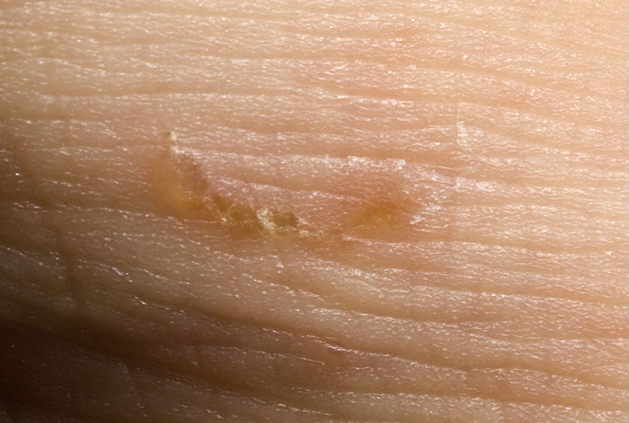
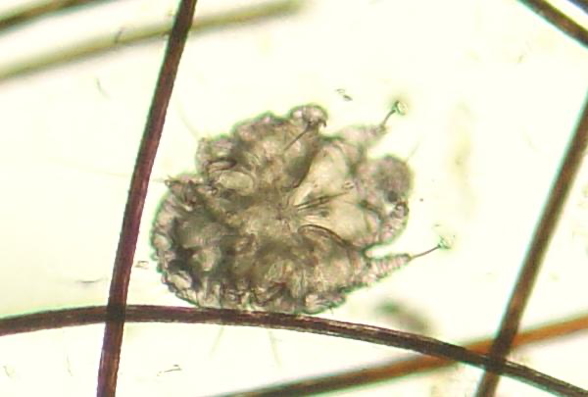
Penarc, CC BY 3.0 <https://creativecommons.org/licenses/by/3.0>, via Wikimedia Commons
Management
Pharmacological
- Topical Permethrin 5% cream (first-line)
- Oral Ivermectin (non-PBS listed, expensive; reserved for crusted scabies or failed topical therapy)
Environmental Measures
- Wash bedding, clothing, and towels
- Sun-dry or use heat exposure
- Clean household surfaces (vacuum, insecticides)
- Crucial for managing crusted scabies due to environmental contamination
Public Health Measures
- Treat all close contacts simultaneously
- Community-wide treatment in outbreak settings (e.g. remote Indigenous communities)
- Repeat treatment after 7 days to target newly hatched mites
Summary – Scabies
Scabies is a contagious skin infestation caused by the mite Sarcoptes scabiei, which triggers intense pruritus and a characteristic rash through superficial burrowing in the stratum corneum. Transmission occurs via close contact, and without appropriate treatment of both the patient and their close contacts, recurrence is common. For a broader context, see our Microbiology & Public Health Overview page.