
Table of Contents
Overview – Measuring Health Concepts
Measuring health concepts is fundamental to understanding diagnostic accuracy, disease risk, and the value of clinical interventions. This page explores essential concepts like sensitivity, specificity, predictive values, risk ratios, and treatment effectiveness metrics—critical knowledge for final-year medical students applying population data to real-world clinical decision-making.
Sensitivity vs Specificity
- Sensitivity
- Ability of a test to detect people who actually have the disease
- High sensitivity → few false negatives
- Formula:
Sensitivity = True Positives / All Actual Positives
→ Represents the percentage of diseased individuals correctly identified
- Specificity
- Ability of a test to correctly identify healthy individuals
- High specificity → few false positives
- Formula:
Specificity = True Negatives / All Actual Negatives
→ Represents the percentage of healthy people correctly excluded
Trade-off Between Sensitivity and Specificity
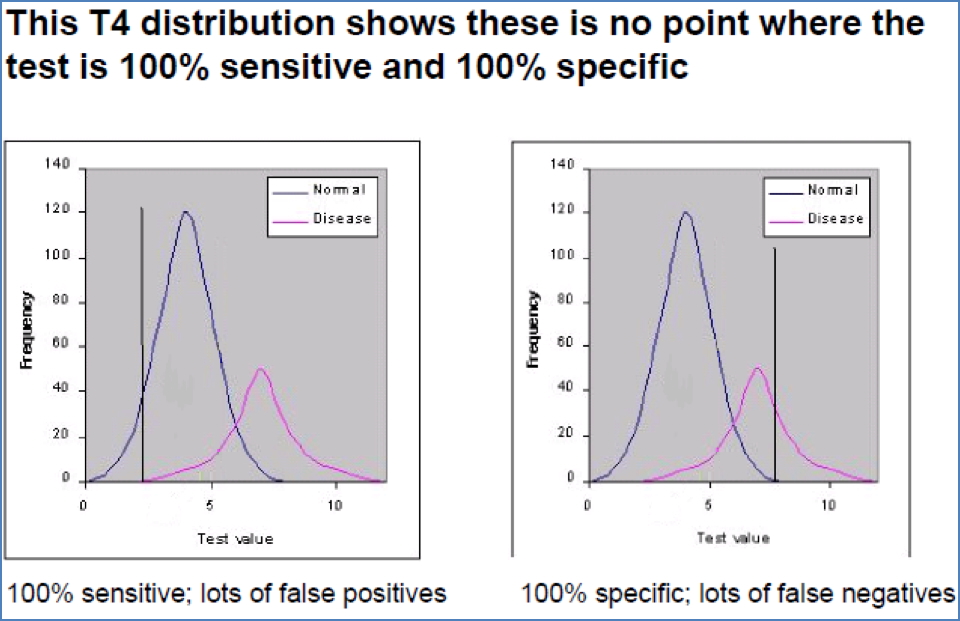
- There is often no point on the test value distribution where sensitivity and specificity are both 100%.
- Diagnostic thresholds must balance the risks of false positives and false negatives.
- Choosing this threshold depends on disease context:
- High sensitivity preferred when:
- Disease is severe or life-threatening
- Treatment is safe, cheap, and widely available
- → e.g. HIV screening in pregnancy
- High specificity preferred when:
- Disease has mild outcomes
- Treatment is invasive, expensive, or risky
- → e.g. Cancer biopsies or surgeries
- High sensitivity preferred when:

Positive Predictive Value (PPV)
- Definition: Likelihood that a positive test result is a true positive
- Formula:
PPV = True Positives / (True Positives + False Positives) - Heavily influenced by disease prevalence in the population
Risk Measurement Metrics
Relative Risk (RR)
- Compares risk between two groups (exposed vs unexposed)
- Interpretation: RR of 2 = exposed group is twice as likely to get the disease
- Commonly used in cohort studies
Rate Ratio
- Compares incidence rates in exposed vs unexposed populations
- Formula:
Rate Ratio = Incidence in Exposed / Incidence in Unexposed - Also used in cohort study designs
Odds Ratio (OR)
- Common in case-control studies
- Formula:
Odds Ratio = (% with disease and exposure) / (% without disease and exposure) - Represents the odds of disease occurrence with a specific exposure

Absolute Risk
- Refers to the true likelihood of developing a disease over time
- Example: Lifetime risk of developing breast cancer ≈ 12%
- Based on prevalence and incidence in the population
Numbers Needed to Treat (NNT)
- Definition: How many patients must be treated to prevent one additional bad outcome
- Ideal NNT = 1 → every patient benefits
- Formula:
NNT = 1 / Absolute Risk Reduction - Example: NNT of 5 → treat 5 people to prevent one adverse outcome
- Helps assess treatment efficiency and cost-effectiveness
Validity and Reliability
- Validity
- Measures how well a test actually assesses what it claims to measure
- Example: Does an IQ test truly measure intelligence?
- Reliability
- Reflects consistency of results across:
- Time
- Different observers
- Varying conditions
- Example: Blood pressure readings using different machines should yield similar results
- Reflects consistency of results across:
Summary – Measuring Health Concepts
This measuring health concepts guide summarises key statistical tools used to interpret diagnostic accuracy, risk, and treatment outcomes in public health. Understanding sensitivity, specificity, predictive values, and NNT enables smarter clinical decision-making. For a broader context, see our Microbiology & Public Health Overview page.