
Table of Contents
Overview – Immune Privileged Sites
Immune privileged sites are anatomical locations in the body where immune responses are tightly regulated or actively suppressed to protect vital or sensitive structures from immune-mediated damage. The best-known examples include the placenta and testes, where immune privilege helps prevent rejection of the semi-allogenic fetus and the immunogenic sperm cells, respectively.
This concept is clinically significant in immunology, reproductive medicine, and autoimmunity. It explains why transplanted tissues in these sites may have prolonged survival and also why certain infections can persist undetected by the immune system.
Definition
Immune privileged sites are areas of the body where immune activity is limited or altered to avoid collateral tissue damage or to protect unique cell populations from immune attack.
Placental Immunology
Why the Foetus is Immunogenic
- Foetus is 50% genetically foreign (paternal antigens) → Normally would activate maternal T-cells.
- Despite this, the maternal immune system does not reject the foetus.
Medawar’s Three Mechanisms of Foetal Survival
- Altered MHC Expression on Trophoblasts
- No classical MHC-I (HLA-A, HLA-B) expressed on foetal trophoblasts.
- Instead, they express:
- HLA-G → Non-classical, non-polymorphic → inhibits natural killer (NK) cells
- HLA-C and HLA-E → Also inhibit NK cell activation
- → Prevents maternal T-cell recognition and NK cell attack
- Maternal Immune Modulation
- Trophoblasts secrete cytokines that suppress local T-cell activity
- Systemic hormones like progesterone and human chorionic gonadotropin (hCG) have immunosuppressive effects
- Physical Barrier of the Placenta
- Trophoblast layer forms the only direct interface between maternal and foetal tissues
- No vascular continuity between maternal and foetal circulations
- → Prevents direct lymphocyte access to foetal antigens

Testicular Immunology
Why Sperm are Immunogenic
- Sperm are genetically distinct from somatic cells
- Post-pubertal antigen exposure = potential target for immune system
Immune Protection Mechanisms
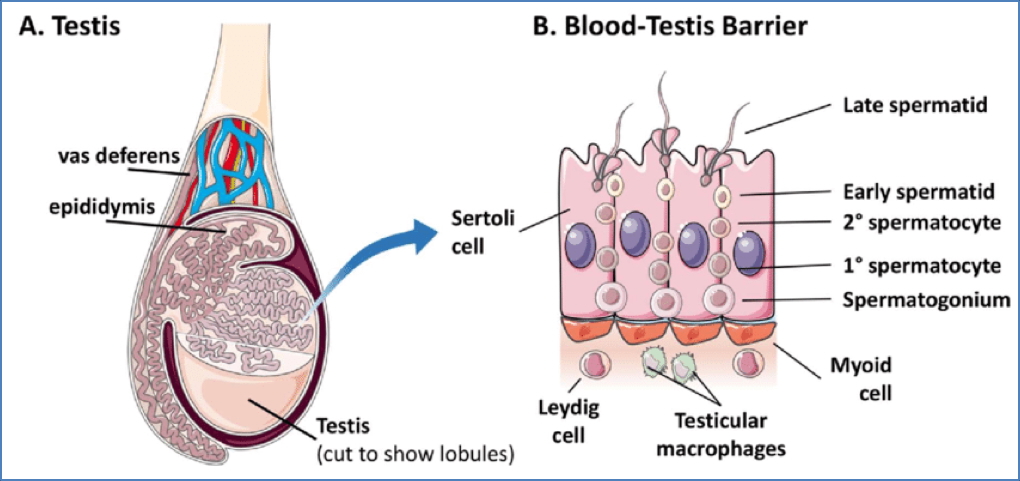
- Blood-Testes Barrier (BTB)
- Tight junctions between Sertoli cells in the seminiferous tubules
- Physically separates developing sperm from systemic immune surveillance
- Disruption of BTB
- Causes: trauma, infection, malformation, obstruction
- → Exposure of sperm to immune system
- → Formation of anti-sperm antibodies
- → Possible autoimmune infertility
Immune Response in the Female Tract
- After intercourse:
- Strong inflammatory response occurs in the female reproductive tract
- Removes excess sperm and pathogens (≈24 hours post-coitus)
- In some cases, anti-sperm antibodies form
- → Potential contributor to female infertility
Summary – Immune Privileged Sites
Immune privileged sites like the placenta and testes use a combination of physical barriers, immune modulation, and altered antigen presentation to evade immune attack. This is crucial for the survival of sperm and the developing foetus, and dysfunction in these systems may lead to infertility or immune pathology. For a broader context, see our Immune & Rheumatology Overview page.