
Table of Contents
Overview – Male Hypogonadism
Male hypogonadism refers to a clinical syndrome caused by insufficient testosterone production or impaired sperm development due to dysfunction of the testes or hypothalamic-pituitary axis. This condition can lead to infertility, sexual dysfunction, and systemic symptoms such as decreased muscle and bone mass. Understanding the distinction between primary (testicular) and secondary (central) hypogonadism is critical for diagnosis and treatment.
Definition
- A condition marked by inadequate testosterone secretion.
- Categorised as:
- Primary Hypogonadism (Hypergonadotrophic) – Testicular failure
- Secondary Hypogonadism (Hypogonadotrophic) – Hypothalamic or pituitary dysfunction
Aetiology
Primary Hypogonadism
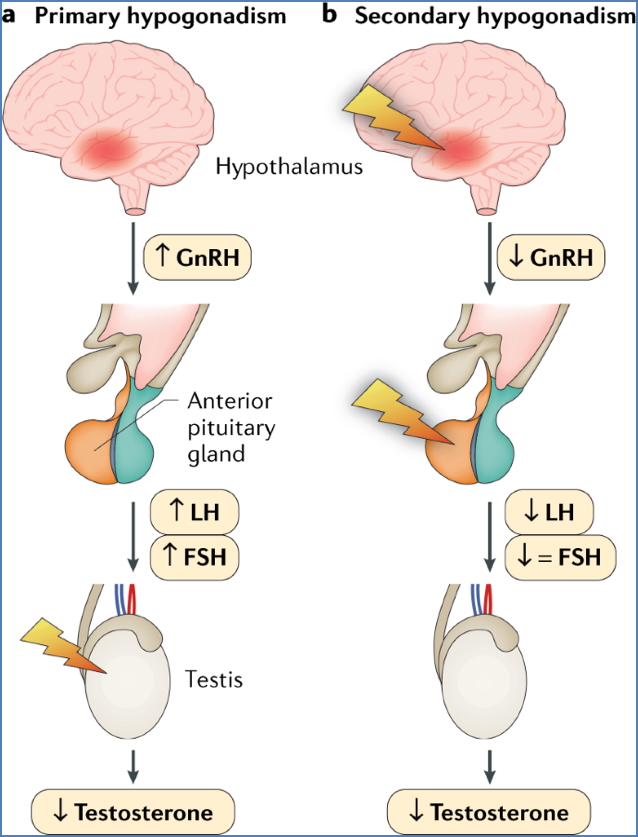
- Defect in the testes → ↓ Testosterone → ↑ Gonadotropins (FSH/LH)
- Causes:
- Testicular trauma or irradiation
- Mumps orchitis
- Klinefelter’s Syndrome (47,XXY)
- Androgen resistance
- Autoimmune destruction
- Congenital testicular abnormalities
Secondary Hypogonadism
- Defect in hypothalamus/pituitary → ↓ GnRH/FSH/LH → ↓ Testosterone
- Causes:
- Congenital developmental disorders
- Pituitary tumours or trauma
- Pituitary irradiation
- Autoimmune hypophysitis
- Genetic syndromes (e.g. Kallmann syndrome)
Pathophysiology
- Primary hypogonadism → Low testosterone, high FSH/LH (loss of negative feedback)
- Secondary hypogonadism → Low testosterone, low/normal FSH/LH (pituitary/hypothalamic issue)
Clinical Features
- Reproductive
- Infertility (low sperm count)
- ↓ Libido
- Erectile dysfunction
- Physical Changes
- ↓ Muscle mass
- ↓ Bone mineral density
- ↓ Beard and body hair
- ↑ Breast tissue (gynaecomastia)
- ↑ Body fat
- Pubertal Delay (in congenital/early-onset cases)
- Lack of secondary sexual characteristics
Investigations
- Serum testosterone
- FSH & LH levels
- GnRH stimulation test (in selected cases)
- Karyotyping (if suspecting chromosomal disorders)
- MRI of pituitary (if secondary cause suspected)
Management
- Testosterone Replacement Therapy (TRT)
- IM, transdermal, or subcutaneous formulations
- Goals: normalise testosterone, improve symptoms, maintain bone density
- Fertility considerations
- Exogenous testosterone suppresses spermatogenesis
- For fertility, use gonadotropins or GnRH therapy instead
- Monitor
- Haematocrit, PSA (in older men), lipid profile, liver enzymes
Summary – Male Hypogonadism
Male hypogonadism is a clinical syndrome due to impaired testosterone production from either testicular failure (primary) or hypothalamic-pituitary dysfunction (secondary). Key features include infertility, sexual dysfunction, muscle loss, and changes in body composition. Treatment typically involves testosterone replacement, though fertility-preserving approaches are used when necessary. For further context, visit our Endocrine Overview page.