
Table of Contents
Overview – Hypoparathyroidism
Hypoparathyroidism is a rare endocrine disorder characterised by inadequate secretion of parathyroid hormone (PTH), resulting in hypocalcaemia and its associated neuromuscular and systemic effects. It is most commonly acquired after neck surgery, particularly thyroidectomy, but may also arise from autoimmune or genetic causes. Early recognition and correction of calcium levels are essential to prevent life-threatening complications such as laryngospasm and seizures.
Definition
- Hypoparathyroidism refers to deficient secretion or activity of parathyroid hormone (PTH).
- PTH normally maintains serum calcium levels via bone resorption, renal reabsorption of calcium, and activation of vitamin D in the kidneys.
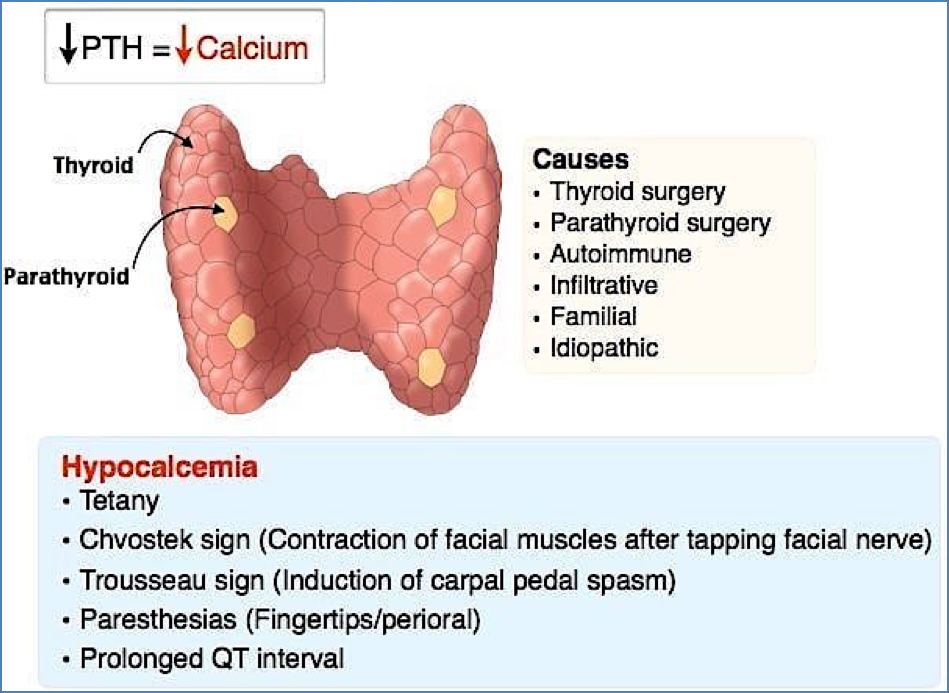
- ↓PTH → ↓Calcium resorption → Hypocalcaemia
Aetiology
Iatrogenic (most common)
- Thyroidectomy
- Parathyroidectomy
- Lymphadenectomy
- Over-resection during treatment of primary hyperparathyroidism
Genetic/Idiopathic
- Congenital absence of parathyroid glands
- Autoimmune destruction (e.g. part of polyglandular autoimmune syndromes)
- Familial hypoparathyroidism
Pathophysiology
- ↓PTH secretion →
- ↓Calcium resorption from bone
- ↓Renal reabsorption of calcium
- ↓Activation of vitamin D (calcitriol)
→ Hypocalcaemia
Clinical Features
Neuromuscular
- Tetany – hallmark of hypocalcaemia
- Distal paraesthesias (fingertips/perioral)
- Carpopedal spasm
- Laryngospasm – life-threatening airway obstruction
- Chvostek’s sign – facial twitching when tapping facial nerve
- Trousseau’s sign – carpal spasm with BP cuff inflation
- Seizures (in severe cases)
Central Nervous System
- Confusion
- Depression
- Hallucinations
- Psychosis
Cardiovascular
- Prolonged QT interval
Ocular
- Cataracts (due to calcium deposition in lenses)
Investigations
- ↓ Serum calcium
- ↓ PTH levels
- Normal or ↑ serum phosphate
- ECG: Prolonged QT interval
Management
- Acute hypocalcaemia (e.g. with tetany/seizures):
- IV calcium gluconate
- Airway support if laryngospasm
- Chronic management:
- Oral calcium supplementation
- Activated vitamin D analogues (e.g. calcitriol)
- Monitor serum calcium and phosphate regularly
Summary – Hypoparathyroidism
Hypoparathyroidism results from insufficient PTH secretion and is characterised primarily by hypocalcaemia. Iatrogenic causes such as thyroid or parathyroid surgery are most common, while autoimmune and congenital cases are less frequent. Tetany, paraesthesia, and prolonged QT interval are key clinical findings. Treatment focuses on calcium and vitamin D supplementation to prevent complications. For more, see our Endocrine Overview page.