
Table of Contents
Overview – Electrolyte Balance
Electrolyte balance is crucial for maintaining cell function, excitable tissue activity, and blood pressure regulation. Sodium, potassium, calcium, and other electrolytes serve essential roles in nerve conduction, muscle contraction, cardiovascular function, and cellular transport. Hormonal regulation, primarily via aldosterone, carefully maintains electrolyte levels within narrow physiological limits.
Definition
- Electrolyte balance refers to the regulation of charged ions (electrolytes) within body fluids.
- Essential for:
- Normal cell function.
- Chemical homeostasis of extracellular and intracellular environments.
- Blood pressure regulation.
- Function of excitable tissues (nerve, cardiac, and muscle).
Major Electrolytes
- Sodium (Na⁺): Major extracellular cation (80% of extracellular osmolality).
- Chloride (Cl⁻): Major extracellular anion.
- Potassium (K⁺): Major intracellular cation (50% of intracellular osmolality).
- Calcium (Ca²⁺): Critical for muscle contraction, cardiac function, nerve conduction, bone formation.
- Magnesium (Mg²⁺): Essential for neurotransmitter (acetylcholine) release, cardiac and neural function.
- Phosphate (HPO₄²⁻): Important for bone formation and energy storage.
Sodium Regulation
Physiological Role
- Key determinant of extracellular fluid volume.
- Directly influences blood pressure via water movement (water follows sodium).
- Essential for nerve and heart function, as well as cellular transport mechanisms.
Hormonal Regulation — Aldosterone
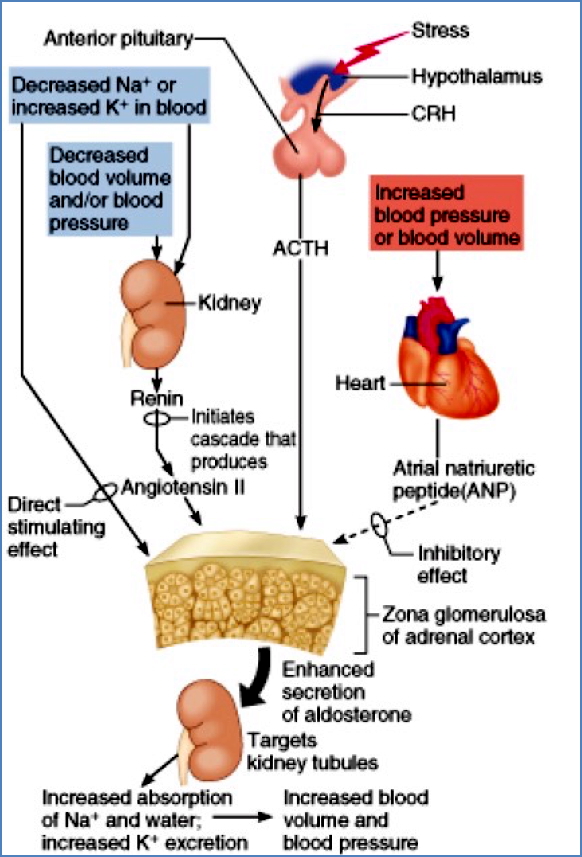
- Secreted by: Zona glomerulosa of adrenal cortex.
- Stimulated by:
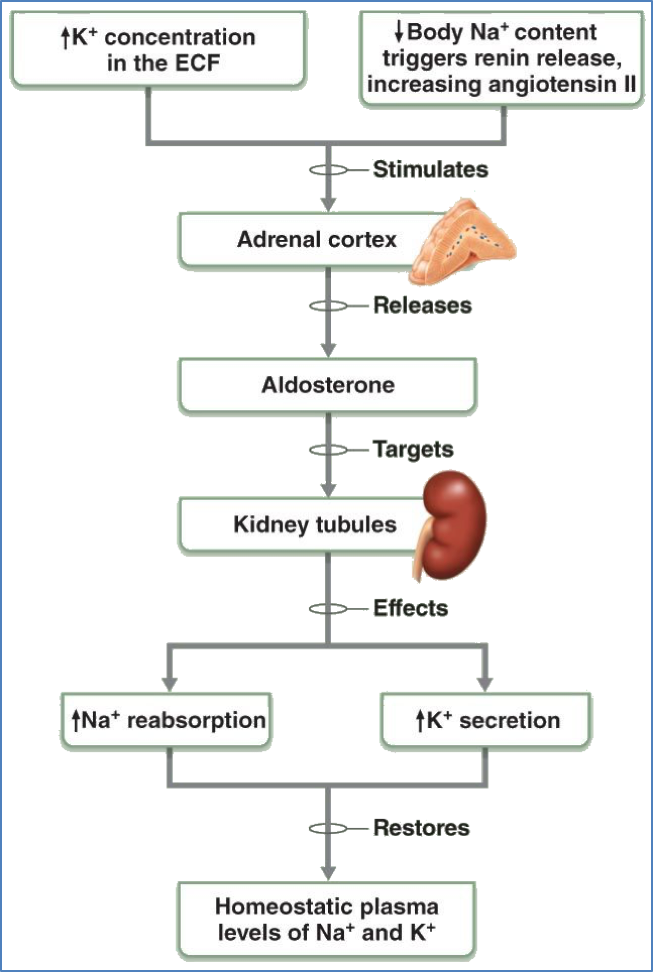
- Angiotensin II (renin-angiotensin system).
- Hyponatremia.
- Hyperkalemia.
- Stress.
Mechanism of Action
- Increases sodium reabsorption in principal cells of distal and collecting tubules.
- If aldosterone levels are high → nearly complete sodium reabsorption.
- If aldosterone is absent → minimal sodium reabsorption.
- Cellular actions:
- Activates Na⁺/K⁺-ATPase pumps → increases Na⁺ & Cl⁻ reabsorption, increases K⁺ secretion.
- Promotes synthesis and insertion of sodium channels into luminal membranes.
Potassium Regulation
Physiological Role
- Crucial for maintaining resting membrane potentials.
- Small changes in extracellular potassium greatly affect cardiac and neuromuscular function.
Effects of Imbalances
- Low intracellular K⁺ (hypokalemia):
- Hyperpolarizes cell membranes → harder to initiate action potentials.
- High intracellular K⁺ (hyperkalemia):
- Depolarizes cell membranes → easier to initiate action potentials.
- Both states are potentially fatal due to cardiac conduction disturbances.
Regulation
- Primarily regulated via renal secretion:
- Principal cells in collecting ducts sense plasma potassium levels.
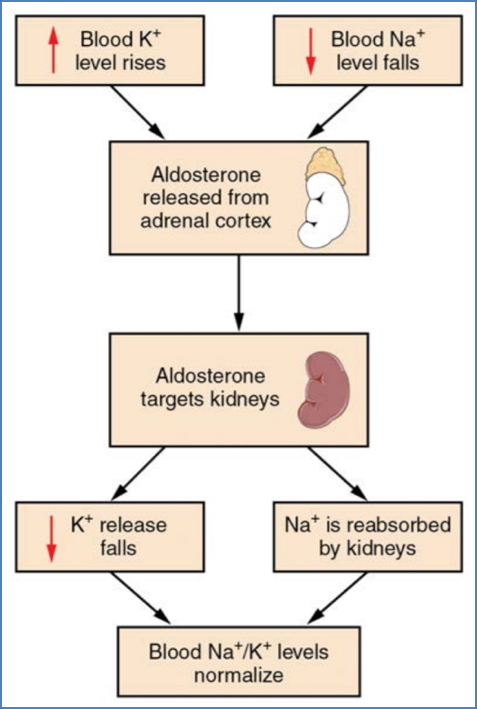
- High plasma [K⁺] → increased K⁺ secretion.
- Aldosterone:
- Directly stimulated by high plasma [K⁺].
- Activates Na⁺/K⁺-ATPase pumps → increases Na⁺ reabsorption and K⁺ secretion.
Summary – Electrolyte Balance
Electrolyte balance, particularly sodium and potassium regulation, is vital for fluid homeostasis, neuromuscular stability, and cardiovascular health. Aldosterone plays a central role in adjusting sodium reabsorption and potassium excretion to maintain homeostasis. For a broader context, see our Endocrine Overview page.